
Why the next wave of enterprise AI adoption will need people who can translate messy reality into working intelligence.
I have been in the technology industry for nearly 30 years. Over that time, I have seen multiple waves of transformation come and go.
Client-server. Enterprise applications. The internet. Digital transformation. Cloud. Automation. And now, AI, GenAI, and Agentic AI.
Each wave arrived with excitement. Each wave promised to change how businesses worked. And each wave also created confusion inside enterprises. Leaders could see the potential, but converting that potential into real business value was never straightforward.
Looking back, one pattern has remained consistent.
Technology alone never drove transformation. People did.
More specifically, transformation was often driven by a critical bridging role — someone who could understand the business, listen to users, map the process, interpret the pain points, and translate all of that into something technology teams could build.
In different eras, we called that person by different names: Business Analyst, Technical Business Analyst, Functional Consultant, Solution Consultant, Business Consultant, Solution Architect, or Transformation Consultant.
Today, in the AI era, we are seeing the emergence of another version of that role: the Forward Deployment Engineer, or FDE.
But I do not see the FDE as a completely new invention. I see it as the next evolution of a role that has always existed whenever technology moved faster than organizations could absorb it.
The difference is that this time, the role is not only about translating requirements into systems.
It is about translating messy enterprise reality into working intelligence.
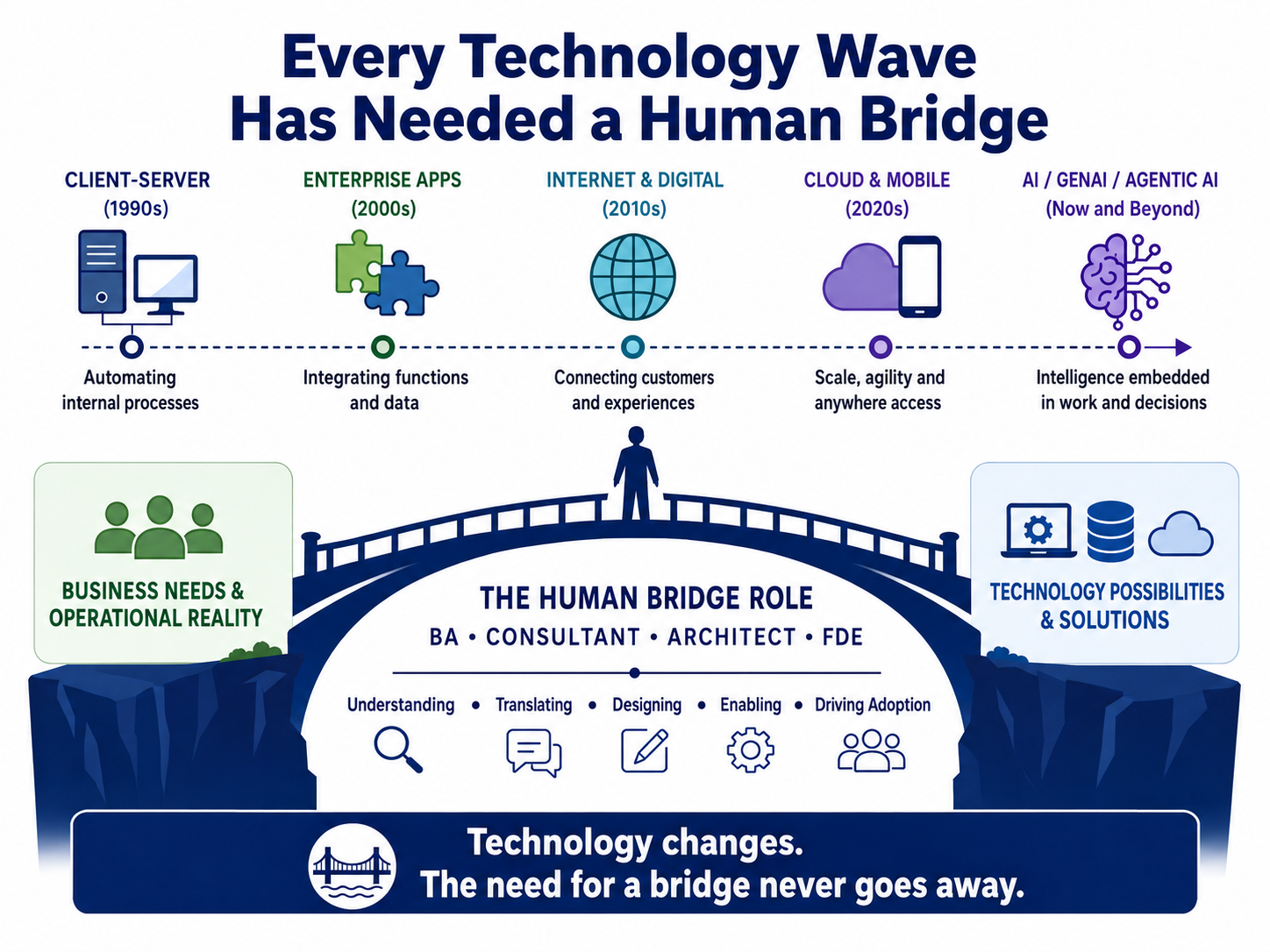
Every Technology Wave Created a Bridge Role
In the early enterprise technology waves, the role of the Business Analyst was critical.
Business users knew what they wanted to improve, but they did not always know how to express it in technical terms. Technology teams knew how to build systems, but they did not always understand the operational reality of the business.
The BA stood in the middle.
They captured requirements. They documented workflows. They clarified rules. They converted business needs into functional specifications. They helped business and technology teams speak a common language.
As enterprises moved into ERP, CRM, BPM, and enterprise process transformation, this role evolved. Functional consultants and business consultants became important because transformation was no longer only about building software. It was about standardizing processes, configuring platforms, aligning stakeholders, training users, and changing ways of working.
Then came the internet and digital transformation era. The bridge role expanded again. It was no longer enough to map internal processes. We had to understand customer journeys, digital channels, user experience, integrations, and faster release cycles.
Then cloud changed the landscape again. Solution architects, cloud consultants, and modernization specialists became central. The conversation moved toward scalability, resilience, security, APIs, migration, cost optimization, and operating model change.
Across all these waves, the core pattern was the same.
Whenever technology created new possibilities, enterprises needed people who could make those possibilities usable, practical, and adopted.
That is the lineage from which I see the Forward Deployment Engineer emerging.
Why AI Changes the Nature of the Role
AI transformation is different from previous technology transformations.
Traditional software was mostly deterministic. You defined requirements, designed workflows, built systems, tested outputs, and deployed the solution. Of course, projects were complex, but the underlying logic was still relatively predictable.
AI is different.
GenAI systems are probabilistic. They respond based on context. They can generate, summarize, classify, reason, retrieve, recommend, and orchestrate. But they also behave differently depending on the data, prompts, workflow design, user behavior, edge cases, and operational environment.
This changes how enterprises must approach adoption.
In traditional IT delivery, you could spend months documenting requirements before building. In AI, many requirements are discovered only when the solution is placed in front of real users and real data.
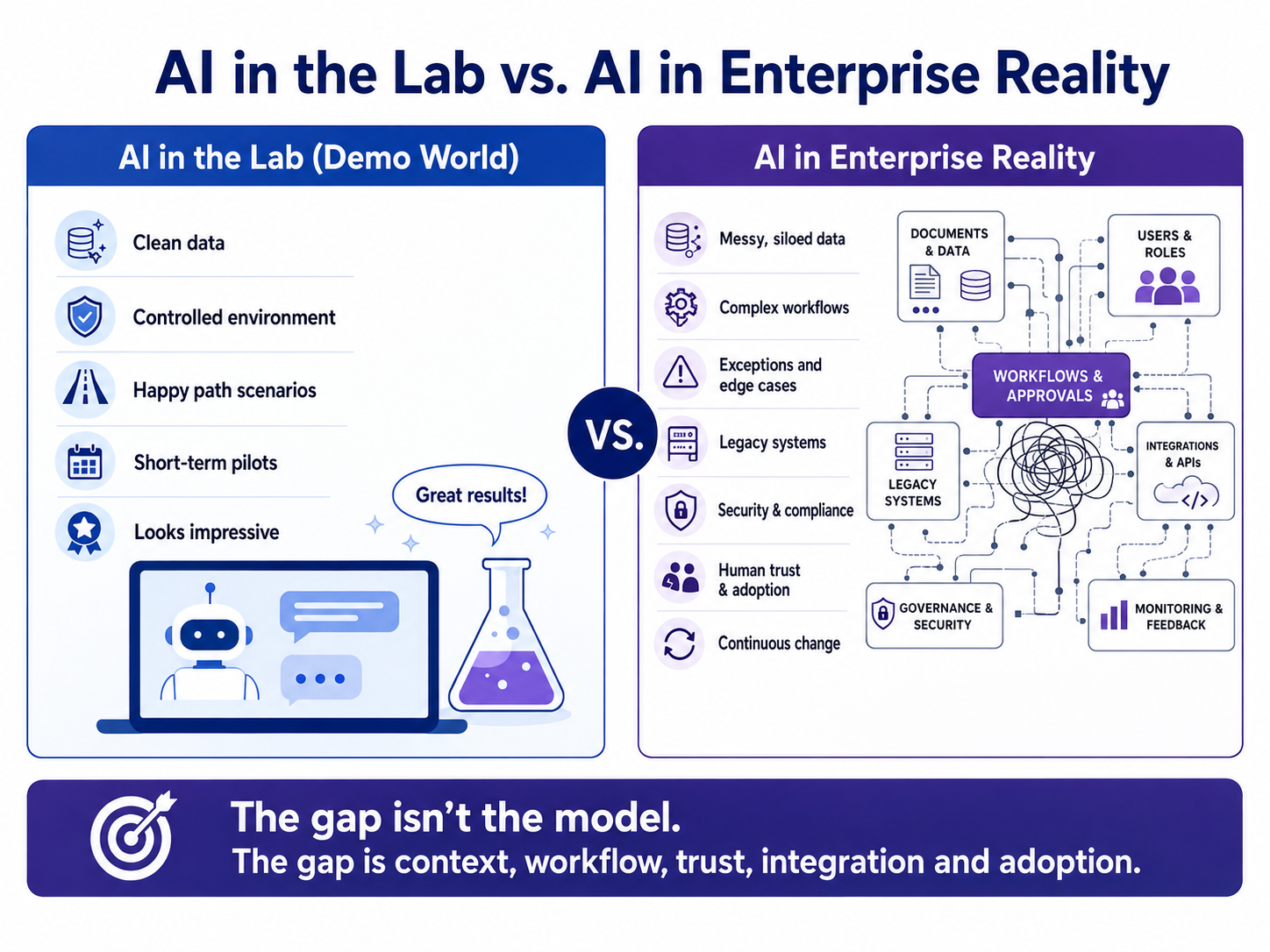
A model may work well in a lab demo but fail when it touches the messy reality of enterprise work.
It may not understand company-specific terminology. It may miss exceptions. It may produce answers that look confident but are incomplete. It may not fit the approval process. It may create trust concerns. It may need access to systems, documents, APIs, identity, audit logs, and governance layers before it becomes useful.
That is why AI adoption often slows down after the proof-of-concept stage.
The issue is not always model capability. The issue is context, workflow, trust, integration, governance, and adoption.
This is exactly where the Forward Deployment Engineer becomes important.
The FDE Is Not Just a BA with AI
It is tempting to describe the FDE as the AI-era version of the Business Analyst. That is partly true, but it is not enough.
If we say the FDE is simply a “BA with AI knowledge,” we reduce the role too much.
A traditional BA was often translation-heavy. They understood the business, documented requirements, and handed them over to delivery teams.
The FDE is execution-heavy.
The FDE still needs to understand the business. They still need to engage stakeholders. They still need to map workflows and identify pain points. But they go further.
They build. They prototype. They integrate. They test with real users. They iterate. They observe how the solution behaves in the field. They help move from idea to adoption.
The old world was often:
Understand → Document → Hand off → Deliver
The FDE world is closer to:
Understand → Build → Deploy → Measure → Iterate
That is the defining shift.
The FDE sits at the intersection of business consulting, product thinking, engineering, AI solution design, and enterprise adoption.
A BA may be strong in problem framing.
An engineer may be strong in building.
A consultant may be strong in strategy.
A solution architect may be strong in architecture.
The FDE combines parts of all these roles, but with a strong bias toward action and outcomes.
What an FDE Actually Does
An FDE does not start by asking, “Which AI tool should we use?”
They start by asking, “Where is work getting stuck?”
That is an important distinction.
Imagine an FDE working with a customer service team. They do not begin by pitching a chatbot. They sit with agents. They observe calls. They look at the knowledge base. They study escalation patterns. They ask why certain cases take longer. They identify where users copy-paste information, where judgment is required, where exceptions happen, where delays occur, and where trust breaks down.
Only after understanding the real workflow do they decide where AI belongs.
Maybe the answer is a RAG-based assistant.
Maybe it is summarization.
Maybe it is automated case classification.
Maybe it is an agent that drafts responses but keeps a human in the loop.
Maybe it is not AI at all, but a simpler workflow or integration fix.
That is why the FDE must not be a hammer looking for an AI nail.
The FDE’s value is not in forcing AI into every process. Their value is in identifying where AI can create real leverage and where it cannot.
A good FDE helps enterprises avoid two common mistakes: chasing shiny AI use cases with little business value, and rejecting AI because early pilots were poorly embedded into real work.
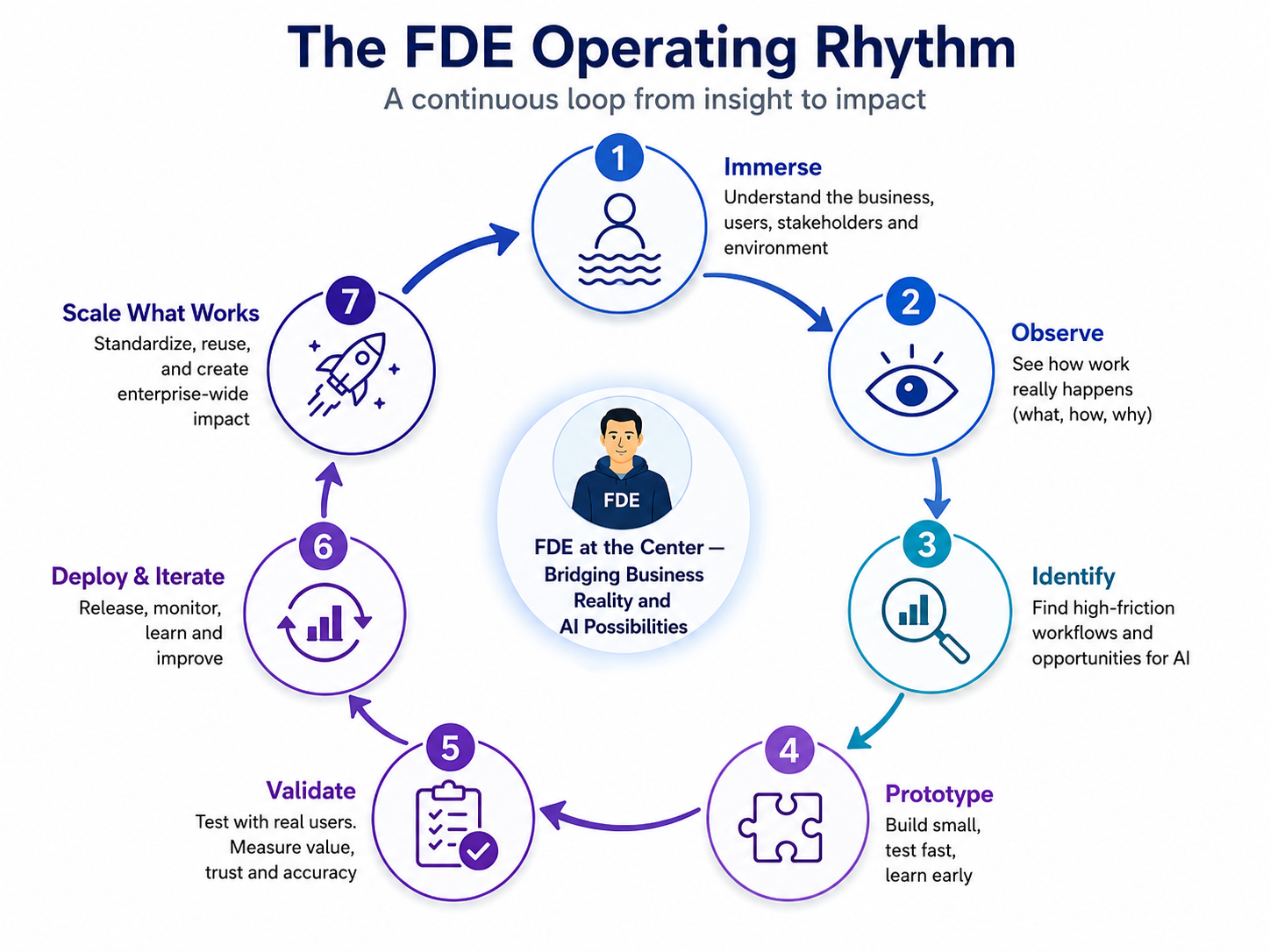
The FDE Operating Rhythm
Over time, I believe successful FDEs will follow a rhythm. Not a rigid methodology, but a practical cadence.
First, they immerse themselves in the business environment. They spend time with users, managers, operations teams, data owners, security teams, and technology teams.
Second, they observe how work actually happens. Not just the documented process, but the real process — the shortcuts, exceptions, decisions, delays, approvals, manual checks, and hidden knowledge.
Third, they identify high-friction workflows. The best AI opportunities are often found where work is repetitive but not fully rule-based, where knowledge is scattered, where decisions require context, or where cycle time is slowed by manual interpretation.
Fourth, they prototype quickly. The goal is not to create a perfect enterprise-grade solution on day one. The goal is to test whether AI can change the workflow in a useful way.
Fifth, they validate with real users. They measure accuracy, usefulness, trust, latency, exception handling, and whether the output actually helps people do their work better.
Sixth, they deploy small and learn fast. Instead of waiting for a large transformation program, they release controlled capabilities, monitor behavior, and improve continuously.
Finally, they scale what works. The patterns that succeed in one workflow can become reusable accelerators, reference architectures, skills, agents, integrations, or platform capabilities.
This is a very different rhythm from traditional transformation.
Traditional transformation often followed:
Assess → Design → Implement
AI transformation increasingly needs:
Try → Measure → Adapt → Scale
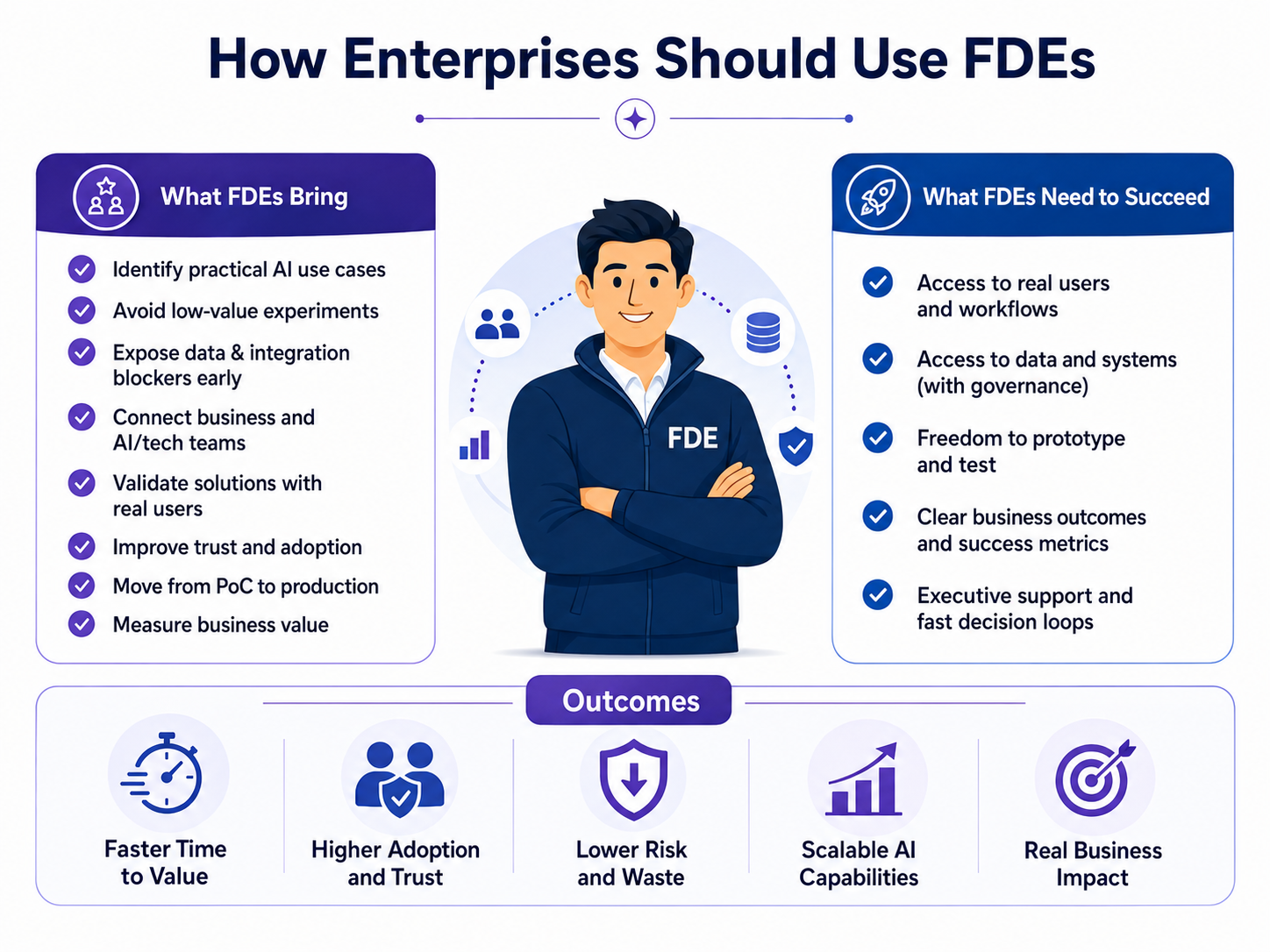
How Enterprises Should Use FDEs
Enterprises should not treat FDEs like normal developers, traditional consultants, or project coordinators.
If you put an FDE into a rigid delivery model with fixed requirements, limited user access, long approval cycles, and no room to experiment, you will destroy most of the value of the role.
FDEs need proximity.
They need access to real business users. They need access to real workflows. They need access to data and systems, within proper security and governance boundaries. They need the ability to prototype and test ideas. They need a clear business outcome to pursue.
Enterprises should use FDEs to accelerate the movement from AI ambition to operational reality.
That means involving them early, not after the strategy has already been written and the solution has already been designed.
A strong FDE can help an enterprise:
- Identify practical AI use cases
- Avoid low-value experiments
- Expose data and integration blockers early
- Connect AI teams with business teams
- Validate solutions with real users
- Improve trust and adoption
- Move from PoC to production
- Measure business value
For service companies, consulting companies, system integrators, and AI solution providers, FDEs can become a strategic capability.
They can help move the conversation beyond slideware and demos. They can sit closer to the customer’s operating reality, identify repeatable patterns, and feed those patterns back into product teams, platform teams, and delivery teams.
How Existing Professionals Can Evolve into FDEs
For Business Analysts, Technical BAs, Solution Consultants, and Solution Architects, the FDE role should not feel alien.
Many of the foundations are already there.
They already know how to speak to stakeholders. They understand requirements. They know how to map processes. They have seen the gap between what business asks for and what technology teams build. They understand that adoption is not automatic.
But to evolve into FDEs, they need to add new capabilities.
They need AI literacy. They need to understand what LLMs can and cannot do. They need to understand prompt design, RAG patterns, agents, APIs, data flows, evaluation, and governance basics.
They do not all need to become deep AI researchers. But they do need to become hands-on enough to shape, test, and challenge AI-enabled solutions.
They also need a stronger product mindset.
An FDE should be comfortable asking: What is the smallest useful version we can test? What metric will prove value? What failure modes should we expect? What should remain human-controlled? What should be automated? What should not be automated?
This is where the role becomes powerful.
It allows experienced transformation professionals to evolve from documentation and advisory work into hands-on AI-enabled transformation.
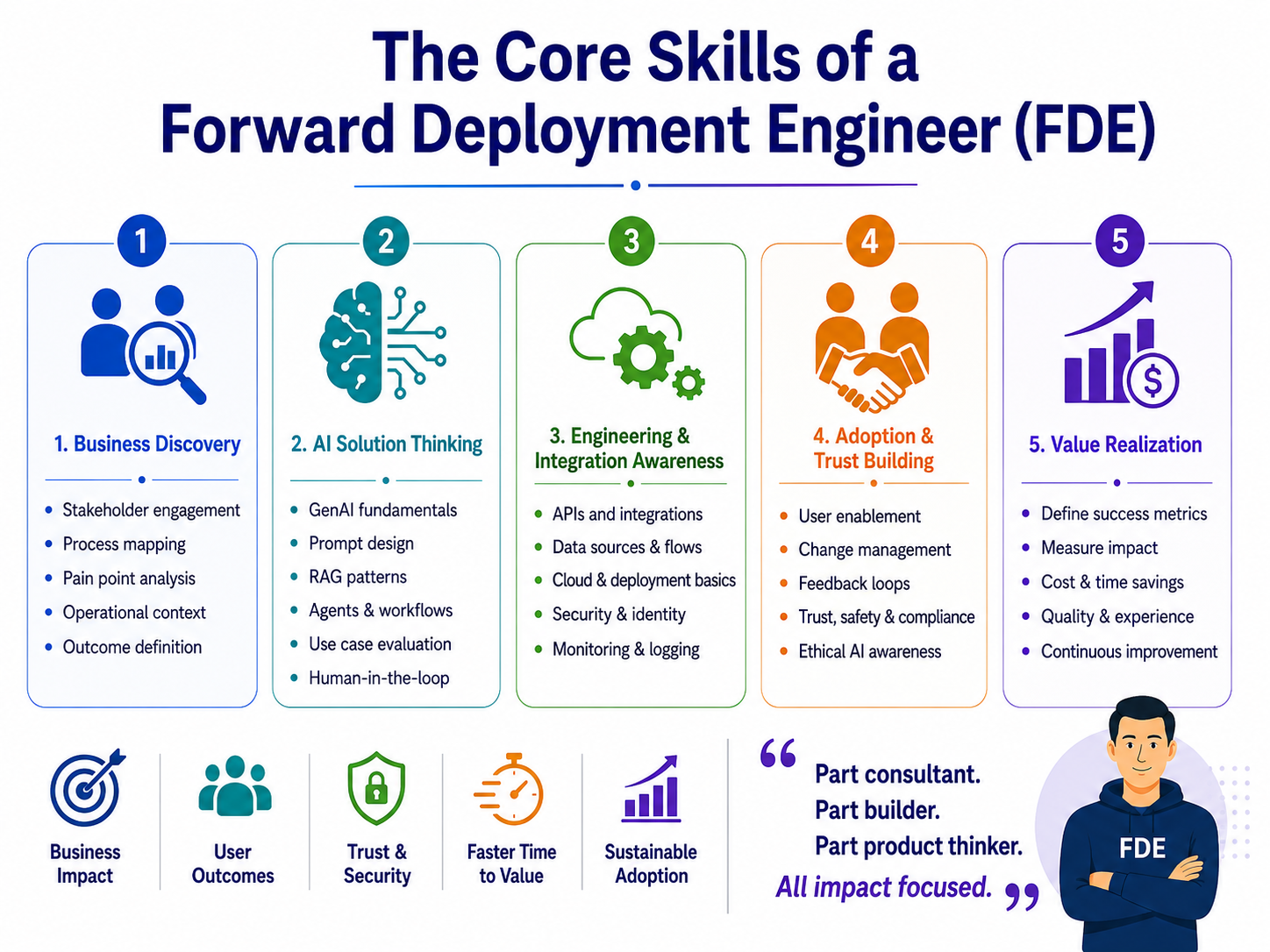
The Core Skills of an FDE
If I had to summarize the FDE skill set, I would group it into five clusters.
1. Business Discovery
FDEs must understand workflows, stakeholders, pain points, decisions, and operating models.
2. AI Solution Thinking
They must know when to use GenAI, RAG, agents, automation, traditional software, or no technology at all.
3. Engineering and Integration Awareness
They must understand APIs, data sources, cloud platforms, identity, security, monitoring, and enterprise systems.
4. Adoption and Trust Building
AI solutions fail when users do not trust them. FDEs must know how to bring users into the loop, handle feedback, and design for human confidence.
5. Value Realization
They must connect the solution to measurable outcomes: faster cycle time, improved quality, reduced manual effort, better customer experience, lower operational cost, or improved decision-making.
The best FDEs will not be people who only know AI tools.
They will be people who can walk into a complex enterprise environment, understand how work really happens, identify where intelligence can create leverage, and help convert that opportunity into something usable, trusted, and scalable.
The Next Transformation Bridge
The Forward Deployment Engineer is not a passing buzzword. It is a response to a real enterprise problem.
AI is powerful, but it does not automatically become business value. Enterprises do not transform simply because they buy AI platforms, subscribe to models, or launch pilots.
They transform when AI is embedded into real work.That requires people who can understand business context, build with technology, navigate ambiguity, work with users, respect governance, and iterate toward outcomes.
That is why I see the FDE as the next transformation bridge.
The BA helped translate business needs into software requirements.
The solution consultant helped translate business processes into enterprise platforms.
The solution architect helped translate business ambition into scalable technology design.
The Forward Deployment Engineer now helps translate enterprise work into AI-enabled operating models.
The title may be new. The need is not. What is new is the nature of the technology — and the speed at which organizations must learn how to use it.
The next decade of enterprise AI will not be defined only by better models. It will be defined by the people who know how to deploy intelligence into real work.
And that is why the Forward Deployment Engineer matters.
Future of Work Series — Reflections on how AI, automation, and enterprise transformation are reshaping roles, skills, and operating models.

