Applied AI Series: The Agentic AI Sprawl Challenge

Executive Summary:

  • AI systems accumulate hidden “sprawl” across tools, prompts, workflows, and context.
  • Sprawl increases cost, risk, and operational friction.
  • A modular, governed architecture reduces chaos and improves reliability.
  • Treat sprawl as a first‑class design problem, not an afterthought.

Introduction

Enterprises are increasingly trying to move fast in adoptic Generative AI and Agentic AI solutions and they are doing so rightly. The reasons are,

  1. The opportunity is real: automation at scale, faster decision-making, and entirely new operating models.
  2. The prolifiration and maturing of tecnology and capabilities around Generative and Agentic AI space

At the same time there is new set of challenges that are emerging from early adopters:

Agentic AI, if left ungoverned, will create the next wave of enterprise tech debt and there is high possibility it will be faster than any prior paradigm.

What we are beginning to see is not just experimentation, but uncontrolled proliferation. The industry has started to call this “Sprawl.” and there has been many discussions, research and solutions being proposed to address the challenge.

In this article wanted to briefly introduce the readers to the concept of sprawl in Agentic AI adoption, the various types of sprawl, its impact and some suggestions on how it can be handled.


What is “Sprawl” in Agentic AI?

In simple terms, sprawl is what happens when innovation and adoption outpaces control.

In Agentic AI, it manifests as:

  • Too many agents
  • Too many tools and integrations
  • Too many models
  • Too many versions of prompts, workflows, and data pipelines

—all built independently, without a common governance, principles and unifying architecture.

This can result in introducing fragmentation, inconsistency, and risk.

While sprawl is not new to enterprise technology adoption, the pace at which Agentic AI can proliferate is unprecedented. Unlike previous technology paradigm shifts, the low barrier to entry and rapid capability maturation means sprawl can become unmanageable at scale far more quickly—making early governance not just prudent, but essential.


The Types of Sprawl

Before diving into talking about the various types of sprawl in the Agentic AI space, it is good to understand the Anotomy of an Agent. As shown in the below image an Agent sits at the middle of universe of capabilities. It expands outward through the tools it uses, the models it runs on, the prompts that guide it, the data it consumes, and finally the operational concerns of memory, identity, orchestration, observability, and cost.
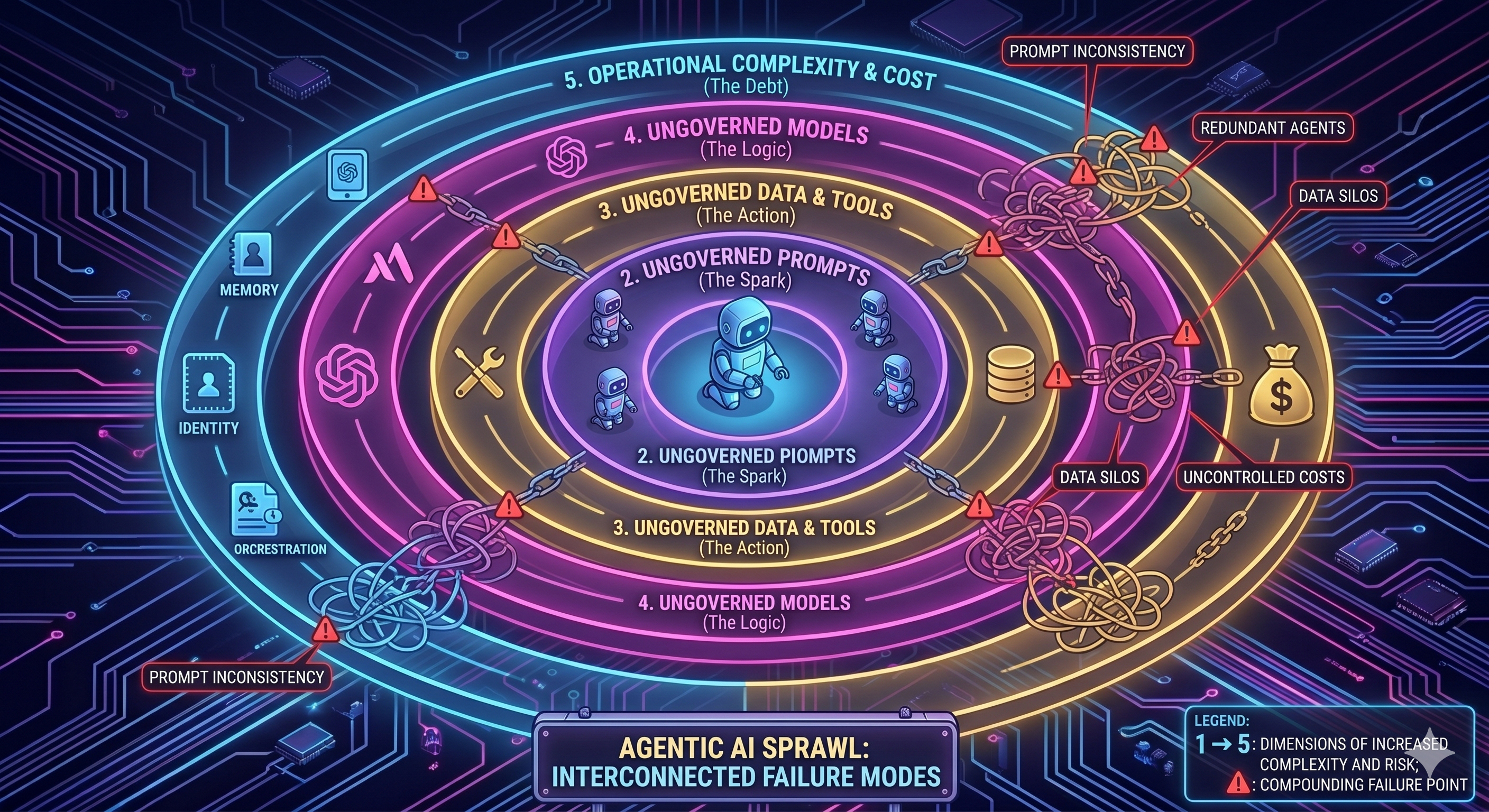
Each ring represents a dimension where uncontrolled growth compounds the ones before it.* An ungoverned agent spawns ungoverned tool integrations. Ungoverned tools expose ungoverned data. Ungoverned data creates ungoverned cost and compliance risk.

Understanding sprawl this way makes one thing clear: these are not isolated problems—they are interconnected failure modes. Addressing only one or two of them is insufficient.


In this section we will cover the various types of Sprawl across the multiple dimensions.

1. Agent Sprawl

Cause :

Teams rapidly build agents for similar use cases without coordination.

Real-world pattern: Customer service, sales, and operations teams each deploy their own “assistant” with overlapping responsibilities.

Impact:

  • Duplicate capabilities
  • Inconsistent outcomes
  • No clear ownership or lifecycle

2. Tool and Integration Sprawl

Cause :

Agents directly integrate with enterprise systems using inconsistent approaches.

Real-world pattern: Some agents call APIs directly, others use middleware, and some embed credentials in code.

Impact:

  • Security exposure
  • Tight coupling to backend systems
  • High maintenance overhead

3. Model Sprawl

Cause :

Different teams adopt different models without alignment.

Real-world pattern: Multiple LLM providers and open-source models used for similar workloads.

Impact:

  • Inconsistent responses
  • Cost inefficiency
  • Compliance risks (data handling, residency)

4. Prompt Sprawl

Cause :

Prompts evolve independently with no versioning or validation.

Real-world pattern: Multiple prompt variations exist for the same use case, with no clarity on which is production-grade.

Impact:

  • Unpredictable behavior
  • Difficult debugging
  • No auditability

5. Data and Context Sprawl

Cause :

Uncoordinated data usage across RAG systems and vector stores.

Real-world pattern: Same datasets embedded multiple times with different configurations.

Impact:

  • Inconsistent answers
  • Increased cost
  • Data governance gaps

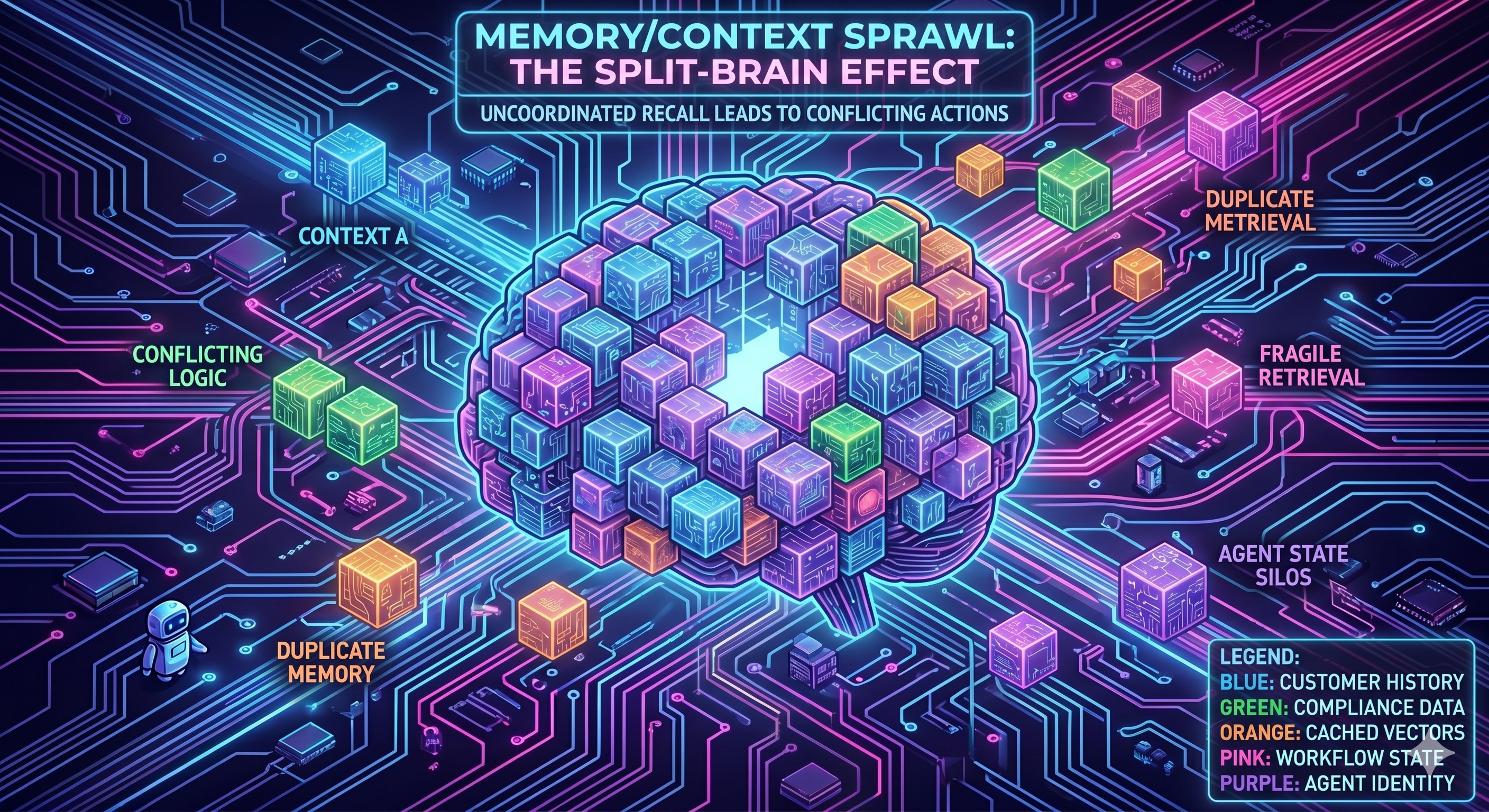
6. Memory Sprawl

Agents maintain fragmented memory across multiple stores.

Impact:

  • Conflicting context
  • Privacy risks
  • Difficult to trace decision logic

7. Identity and Authorization Sprawl

Cause :

No unified identity model for agents and tools.

Real-world pattern: Agents using ad hoc credentials or inconsistent authentication mechanisms.

Impact:

  • Security vulnerabilities
  • No enforcement of least privilege
  • Limited auditability

8. Workflow and Orchestration Sprawl

Cause :

Multiple orchestration patterns emerge across teams.

Impact:

  • Lack of reuse
  • Difficult troubleshooting
  • Inefficient execution

9. Observability and Governance Sprawl

Cause :

Monitoring and control are fragmented across tools.

Impact:

  • Limited visibility
  • Slow incident resolution
  • Compliance exposure

10. Cost Sprawl

Cause :

AI costs grow without clear ownership or optimization.

Impact:

  • Budget overruns
  • No cost attribution
  • Inefficient usage patterns

The Core Issue: Decentralized Innovation Without Central Control

None of the above is surprising.

Agentic AI lowers the barrier to building intelligent systems. That is its strength—but also its risk.

Without a central architecture and control plane, every team optimizes locally, and the enterprise suffers globally.


The Consequence: Silent, Compounding Tech Debt

This is where the real risk lies.

Unlike traditional systems, Agentic AI systems are probabilistic, dynamic, and interconnected. When sprawl sets in:

  • Fixing behavior becomes harder over time
  • Security gaps multiply silently
  • Costs compound without visibility
  • Governance becomes reactive instead of proactive

This is not immediate failure—it is slow degradation.

And by the time it is visible, the cost of correction is significantly higher.


The Enterprise POV: Governance Must Come First, Not Later

There is a common approach being adopted today:

> “Let teams experiment first, we will standardize later.”

This approach worked (to some extent) in earlier paradigms.

It will not work for Agentic AI at scale.

Why?

  • Agents make decisions, not just execute code
  • They interact with sensitive systems and data
  • They evolve through prompts, memory, and context

Retrofitting governance later is significantly harder and more expensive.


What Must Be Put in Place Upfront

To avoid long-term tech debt, enterprises must establish the following from the start:

1. Architecture Principles

  • Define a standard architecture for agents, tools, memory, and models
  • Introduce a central control plane (platform approach)

2. Design Principles

  • Reuse over duplication (skills, tools, workflows)
  • Loose coupling via controlled interfaces
  • Policy-driven access to systems and data

3. Governance Framework

  • Agent registration and lifecycle management
  • Model and prompt governance
  • Data usage and lineage controls

4. Security and Identity Model

  • Identity for every agent
  • Fine-grained authorization for tool access
  • Secure agent-to-agent communication

5. Operational Controls

  • Unified observability (logs, traces, metrics)
  • Cost tracking and attribution
  • Runtime policy enforcement

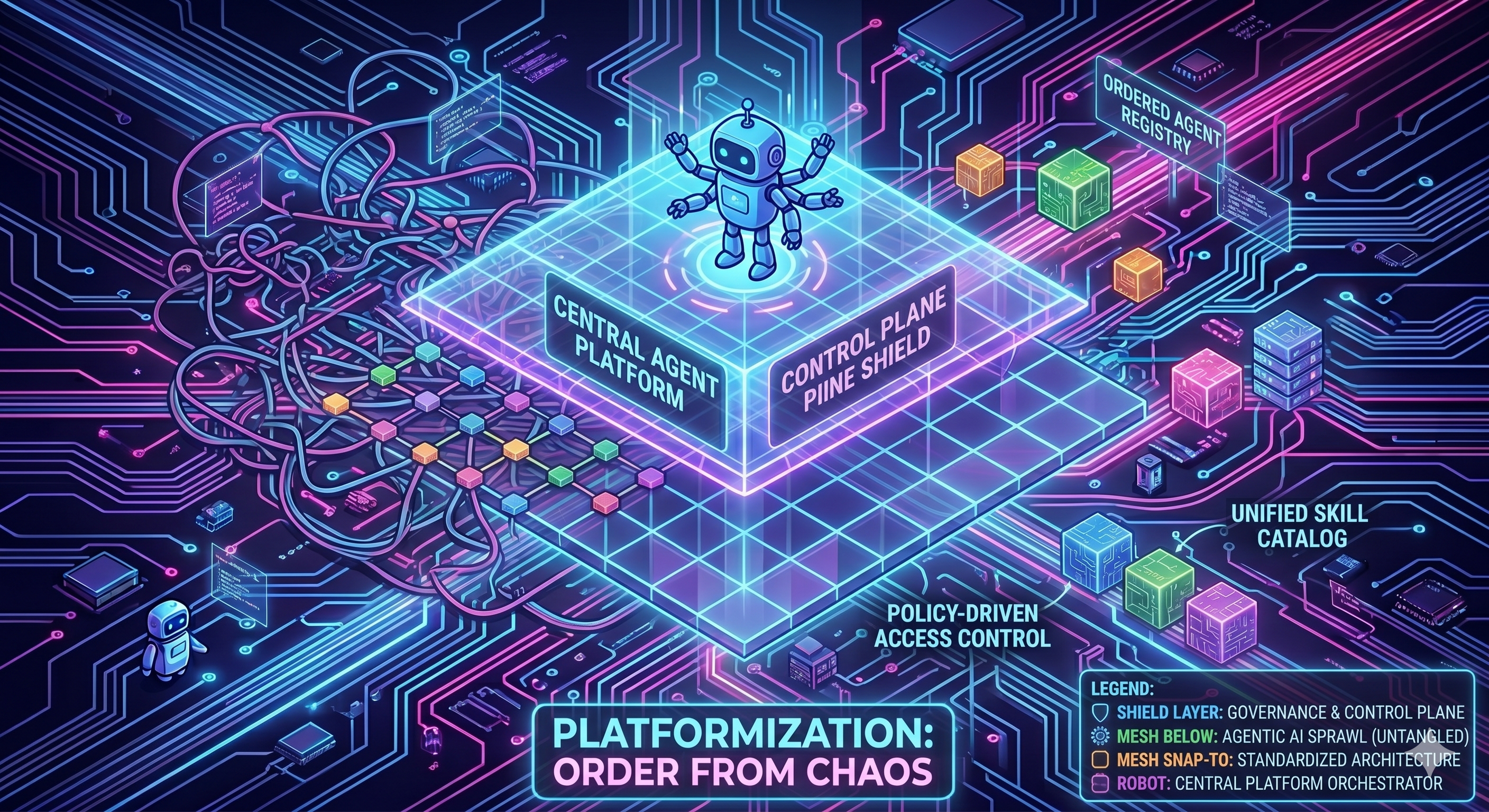
The Practical Direction: Platformization

The direction is becoming clear across the industry:

Enterprises need an Agent Platform—not just agent frameworks.

A platform approach provides:

  • Standardization
  • Governance
  • Reuse
  • Observability
  • Security

—while still enabling teams to innovate.
Final Thoughts

Agentic AI is not just another technology layer—it is a new execution model for enterprises.

With that comes a responsibility:

Design for control before scale.

Organizations that ignore sprawl will move fast initially—but will slow down later under the weight of complexity, risk, and cost.

Organizations that address it early will build systems that are not just powerful, but sustainable and scalable.

The choice is not between speed and governance.

The real choice is whether to pay the cost now—or pay significantly more later.

Author’s Note: AI-assisted writing tools were used to support the creation of this post. All concepts, perspectives, and the underlying thought process originate from me; the AI served only as a drafting and refinement aid

Published by Sri Rajalingam

CTO, Entrepreneur, Technology Evangelist & Trainer focused on building companies and helping Enterprises Apply and Adopt AI and Cloud to that cna help them to create real, measurable impact. View all posts by Sri Rajalingam
The Applied AI : Understanding the AI Landscape – Part 1 Blog Post 4

Working of the 4 Pillars and 5 Layers Framework

Introduction

Over the past three posts, I had shared the mental model for understanding the AI landscape piece by piece.

In Blog 2, I had introduced the 4 Pillars—the horizontal dimension that categorizes AI by where it is applied:

  • Consumer AI (speed and UX)
  • Enterprise AI (reliability and integration)
  • Science AI (precision and discovery)
  • Physical AI (safety and real-world interaction)

In Blog 3, we introduced the 5 Layers—the vertical dimension that tracks how various aspects of AI creates impact:

  • Hardware (Foundation)
  • Models (Intelligence)
  • Agents & Tools (Orchestration)
  • Applications (Interface)
  • Impact (Value)

Individually, each dimension is useful. But their real power emerges when you combine them into a matrix. In this post, we bring the two together—and I think the result will be the most practically useful idea you will learn.

The Building Construction Analogy: Why You Need Two Dimensions

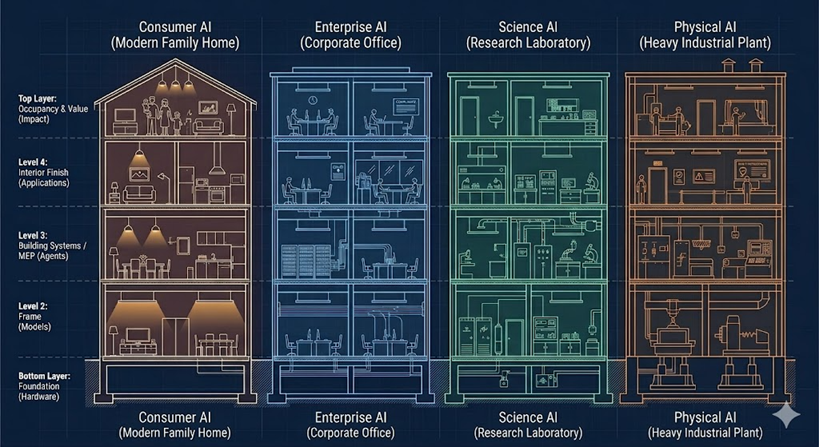
To start with wanted to use a simple Building Construction analogy to explain why combining pillars and layers matters.

Think about what it takes to construct a building. Before a single brick is laid, two questions define everything about how the project will be managed, what standards apply, and what failure means:

  1. What type of building are you constructing? A family home, a corporate office tower, a research laboratory, or an industrial plant?
  2. What phase of construction are you in? Laying the foundation, erecting the structural frame, running the building systems, finishing the interiors, or handing it over to occupants?

Either question alone tells you something. But neither tells you enough.

Knowing you are in the “electrical wiring phase” tells you the work involves circuits, conduit, and power loads. But it tells you nothing about what that work actually demands. Wiring a family home means standard outlets, consumer-grade cable, and a one-day inspection. Wiring a hospital means medical-grade isolation transformers, redundant emergency circuits, life-safety compliance reviews, and weeks of testing. The phase name is identical. The engineering reality could not be more different.

You need to know both the building type and the construction phase to understand what you are really dealing with.

This is exactly how the AI landscape works:

  • The Pillar tells you what type of “building” you are constructing—Consumer AI (a well-appointed home: built for comfort, speed, and personal delight), Enterprise AI (a commercial office tower: governed, integrated, inspected at every phase), Science AI (a precision research laboratory: every measurement matters, everything must be validated), or Physical AI (an industrial plant or a bridge: safety-critical, certified at every layer, because failure is not an option).
  • The Layer tells you what construction phase you are in—Hardware (the foundation and site work), Models (the structural frame), Agents & Tools (the MEP systems—mechanical, electrical, plumbing—the systems that make the building actually function), Applications (the interior finish: what occupants see and interact with), or Impact (occupancy and value: what the building delivers when people use it).

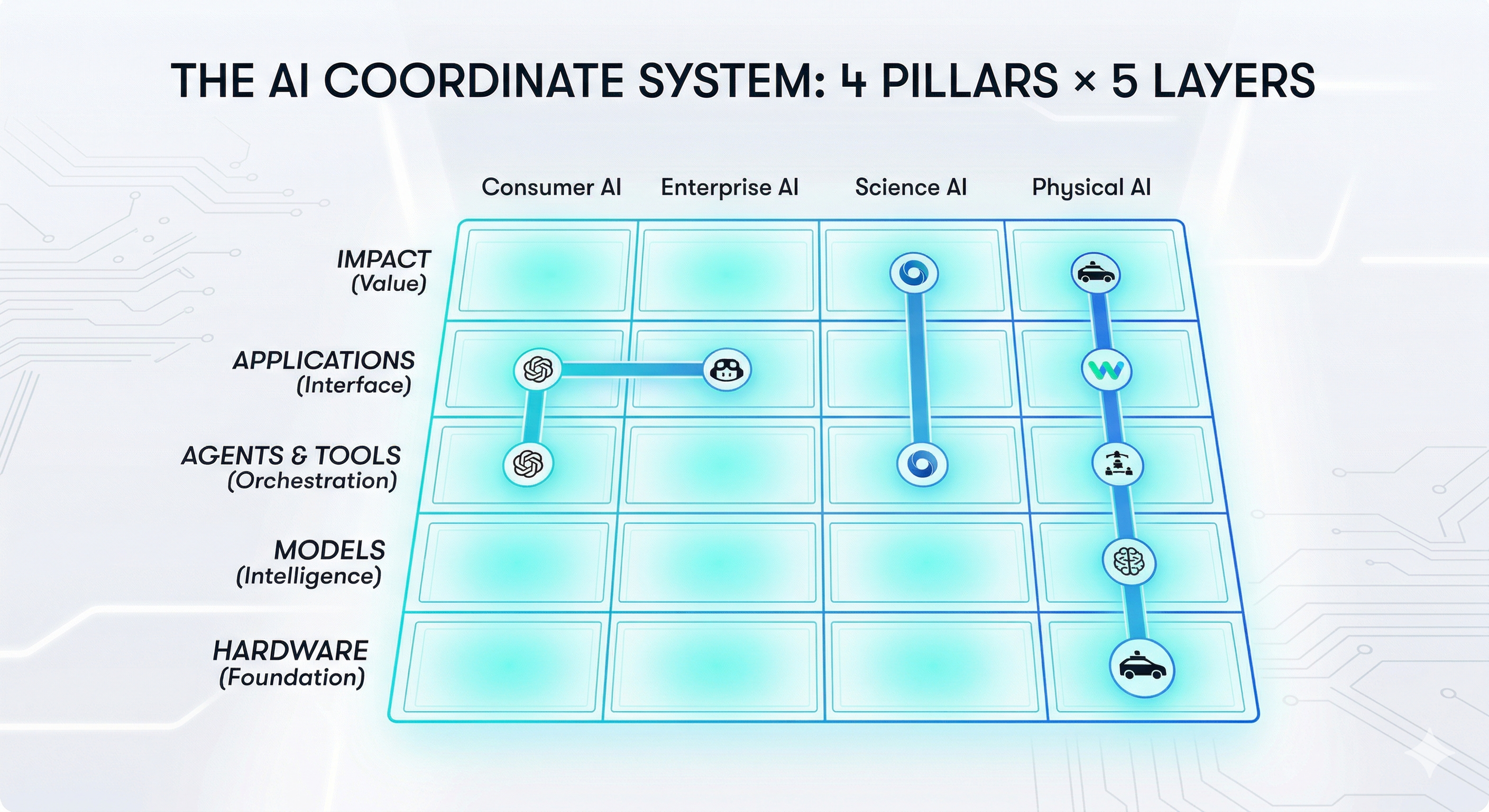
When you combine these two dimensions, you get a blueprint grid—a 4×5 matrix that lets you place any AI development into a specific, meaningful position. And just like an architect reading a blueprint instantly understands that “running MEP systems in a hospital” is an entirely different undertaking than “running MEP systems in a family home,” your position on this grid instantly reveals the constraints, timelines, and risks of any AI initiative.

The goal of this framework is not a classification exercise. It is to give you a decision tool—a way to read any AI initiative the way an experienced architect reads a blueprint: understanding what it truly demands before you commit to building it.

The Matrix: Your AI Blueprint Grid

When you are embarking on an AI initiative, the grid gives you four immediate questions to answer—each one revealing a different dimension of what the work actually demands:

  • Which layers require investment (Do you need custom hardware, or can you use existing infrastructure?)
  • What constraints will dominate (Is speed critical, or is accuracy non-negotiable?)
  • Where dependencies lie (Does your application layer depend on breakthroughs in the model layer?)
  • What adjacent developments matter (If you are building in Enterprise AI Layer 3, what’s happening in Consumer AI Layer 3 might signal future trends)

This blueprint grid transforms AI from an overwhelming landscape into a structured plan. Instead of asking “How do I keep up with AI?”, you can ask “What’s happening at the specific position in the grid which is my area of focus, and in the adjacent cells that matter?”

How the Same Layer Behaves Differently Across Pillars

Here is the key insight that makes this matrix powerful, not just being an academic excercise: the same layer behaves radically differently depending on which pillar you are in.

As with the wiring example—the phase name is the same, but the demands are not. Let me show you how this plays out with Layer 2 (Models), since that is the layer most people associate with “AI.”

  • A Consumer AI Model (like ChatGPT) is optimized for speed, creativity, and conversational flow. Accuracy is important, but a small mistake is forgiven. Users regenerate and move on.
  • An Enterprise AI Model used for financial reporting must be bulletproof. A hallucination here is not an inconvenience—it is a legal liability.
  • A Science AI Model (like AlphaFold) must model the laws of physics accurately. “Close enough” is not acceptable when the output determines whether a drug candidate moves to clinical trials.
  • A Physical AI Model controlling a robot arm must respond in milliseconds and never fail catastrophically. A wrong prediction is not a bad answer—it is a collision.

Same layer. Radically different behavior, constraints, and success criteria.

This pattern holds across every layer. To make it concrete, here is how Layer 1 (Hardware) and Layer 3 (Agents) look across all four pillars:

Hardware (Layer 1) Across the Pillars

Pillar Hardware Need Key Constraint Example
Consumer Smartphones, laptops, edge devices Cost and battery life—users won’t carry a $5,000 device Apple’s Neural Engine running AI locally on iPhones
Enterprise Cloud data centers with GPUs Cost per query at scale—$0.10 per query × 1M daily queries = unsustainable Microsoft Azure GPU clusters powering Copilot
Science HPC clusters, specialized TPUs Raw computational power—simulating molecular interactions requires massive parallelism Google’s TPU pods training AlphaFold
Physical Edge compute on robots, real-time processors Ruggedness and power efficiency—a warehouse robot can’t be plugged into a wall NVIDIA Jetson chips in autonomous delivery robots

Agents & Tools (Layer 3) Across the Pillars

Pillar Agent Role Key Constraint Example
Consumer Personal assistants for daily tasks User trust and simplicity—complexity drives abandonment Google Assistant coordinating calendar, email, and maps
Enterprise Workflow automation (tickets, reports, routing) Reliability and auditability—a wrong ticket priority creates business risk Salesforce Einstein automating support triage
Science Research agents proposing hypotheses, searching databases Accuracy and domain expertise—a wrong hypothesis wastes months of lab work AI agents in drug discovery suggesting molecular candidates
Physical Control agents coordinating sensors, motors, navigation Real-time safety—a 100ms delay can cause a collision Waymo’s vehicle agent orchestrating perception, planning, and control

The Speed Paradox: Why Each Pillar Evolves Differently

One of the most practically useful insights from this framework is understanding why different AI domains move at different speeds. This is something I wish more people internalized, because it is the antidote to AI FOMO.

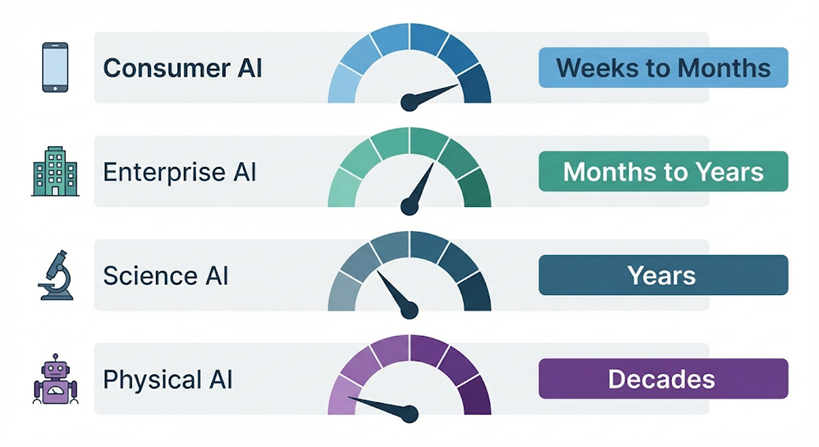
Consumer AI moves at software speed. New features ship weekly. ChatGPT’s interface changes monthly. A startup can go from idea to launch in weeks. Why? Because the constraints are lightweight—you need a fast model, a clean UI, and an internet connection. Layer 1 (Hardware) is someone else’s problem (cloud providers). Layer 5 (Impact) is measured in engagement, not life-or-death outcomes.

Enterprise AI moves at integration speed. Deployments take months to years. Why? Because Layer 3 (Agents) must connect to legacy systems, Layer 4 (Applications) must satisfy compliance and security reviews, and Layer 5 (Impact) must be measured in ROI—not vibes. Every new AI capability must pass through governance, procurement, and change management before it reaches a single employee.

Science AI moves at validation speed. Breakthroughs like AlphaFold take years to move from paper to practice. Why? Because Layer 5 (Impact) requires peer review, reproducibility, and cross-domain validation. A model that predicts protein structures must be verified by wet-lab experiments before anyone trusts it for drug design. Science AI changes humanity quietly—you rarely see it in headlines, but its long-term impact often exceeds everything else.

Physical AI moves at certification speed. Self-driving cars and surgical robots operate on timelines measured in decades. Why? Because every layer must be near-perfect simultaneously. Layer 1 (Hardware) must survive rain, heat, and impact. Layer 2 (Models) must handle edge cases that have never been seen before. Layer 5 (Impact) involves human safety, which means regulatory certification, insurance frameworks, and public trust—all of which move slowly and for good reason.

Why this matters to any one involved in rolling out AI initiatives: When you see a headline about a “breakthrough” in Physical AI, you can breathe. It will be years before it affects your daily work. When you see a breakthrough in Consumer AI, pay attention—it might change your workflow next month. The pillar tells you how fast the building codes—and the industry around them—are rewritten.

Applying the Framework: A Quick Start

Now that you have seen the matrix in action, here is a quick way to use it when you encounter any AI announcement, product, or project. I will expand this into a full practical methodology in Part 3 of the series, but for now, three questions will get you most of the way:

Question 1: Which pillar? Identify the building type. Is this consumer-facing, enterprise, scientific, or physical? The pillar immediately tells you the dominant constraint (delight, integration, accuracy, or safety) and the likely pace of development—just as knowing whether you are building a home or a hospital tells you immediately what standards, timelines, and failure tolerance apply.

Question 2: Which layers? Identify the construction phase. Which layers is this project investing in? If a company announces a “revolutionary AI product” but only focuses on Layer 2 (the model), it may lack the MEP systems (Layer 3 / Agents) or the finished interior (Layer 4 / Applications) to be usable. You can spot vaporware by identifying the phases that are missing or hand-waved away.

Question 3: Does this affect my position on the grid? The framework gives you permission to ignore 75% of AI news. If an announcement is not in your pillar or an adjacent layer, it is noise. A Science AI breakthrough (like AlphaFold) is fascinating, but if you are building consumer products, it is not immediately actionable.

Example: You read: “New multimodal AI model can understand video, audio, and text simultaneously!”

  • Pillar: Likely Consumer AI (user delight) or Enterprise AI (workflow efficiency).
  • Layers: Primarily Layer 2 (model improvement). But does it have Layer 3 integration or Layer 4 UX?
  • Relevance: If you are building a video editing tool (Consumer), this is highly relevant and could reach your users in months. If you are in healthcare (Enterprise/Science), wait for domain-specific validation—it will take 1-2 years for integration.

In seconds, you have gone from “another overwhelming AI headline” to “I know exactly what this means for me.” That is the power of knowing your position on the grid.

Summary

In this post, we brought together the two dimensions of our framework—the 4 Pillars (where AI applies) and the 5 Layers (how AI creates impact)—into a single coordinate system.

The key insights:

  • The matrix is a decision tool, not just a classification. Like a construction blueprint, your position on the grid reveals the building type (constraints), the construction timeline, and the safety requirements of any AI initiative.
  • The same layer behaves radically differently across pillars. “Models” in Consumer AI means fast and forgiving. “Models” in Physical AI means flawless and real-time. The layer name is identical; the engineering reality is not.
  • Each pillar evolves at its own speed. Consumer AI moves in weeks, Enterprise in months, Science in years, Physical in decades. Understanding this eliminates FOMO and helps you set realistic expectations.
  • You can ignore 75% of AI news. Once you know your building type and construction phase, any announcement outside your pillar and adjacent layers is background noise—interesting, but not actionable for you right now.

With this blog the Part 1 of the blog series is now complete. You now should have a full mental model for understanding the AI landscape. But understanding the structure is just the beginning.

What’s Coming Next: Deep Diving Into Each Pillar

The blog posts in Part 2 of this series, we will take a detailed journey through each pillar, one at a time:

  • Consumer AI: Where AI meets individual users. We will explore personalization, ambient computing, and the race for zero-friction interfaces.
  • Enterprise AI: Where AI meets business processes. We will discuss agentic workflows, data readiness, and why most AI pilots fail.
  • Science & STEM AI: Where AI accelerates discovery. We will look at AI-generated hypotheses, autonomous labs, and humanity-scale breakthroughs.
  • Physical AI: Where AI enters the real world. We will examine robotics, autonomous systems, and the long game of building trust.

Each pillar will be analyzed through the 5 layers, with specific trends, constraints, and decision-making guidance.

By the end of Part 2, you will not only understand the landscape—you will know how to navigate it.

Author’s Note: AI-assisted writing tools were used to support the creation of this post. All concepts, perspectives, and the underlying thought process originate from me; the AI served only as a drafting and refinement aid

Published by Sri Rajalingam

CTO, Entrepreneur, Technology Evangelist & Trainer focused on building companies and helping Enterprises Apply and Adopt AI and Cloud to that cna help them to create real, measurable impact. View all posts by Sri Rajalingam