
Working of the 4 Pillars and 5 Layers Framework
Introduction
Over the past three posts, I had shared the mental model for understanding the AI landscape piece by piece.
In Blog 2, I had introduced the 4 Pillars—the horizontal dimension that categorizes AI by where it is applied:
- Consumer AI (speed and UX)
- Enterprise AI (reliability and integration)
- Science AI (precision and discovery)
- Physical AI (safety and real-world interaction)
In Blog 3, we introduced the 5 Layers—the vertical dimension that tracks how various aspects of AI creates impact:
- Hardware (Foundation)
- Models (Intelligence)
- Agents & Tools (Orchestration)
- Applications (Interface)
- Impact (Value)
Individually, each dimension is useful. But their real power emerges when you combine them into a matrix. In this post, we bring the two together—and I think the result will be the most practically useful idea you will learn.
The Building Construction Analogy: Why You Need Two Dimensions
To start with wanted to use a simple Building Construction analogy to explain why combining pillars and layers matters.
Think about what it takes to construct a building. Before a single brick is laid, two questions define everything about how the project will be managed, what standards apply, and what failure means:
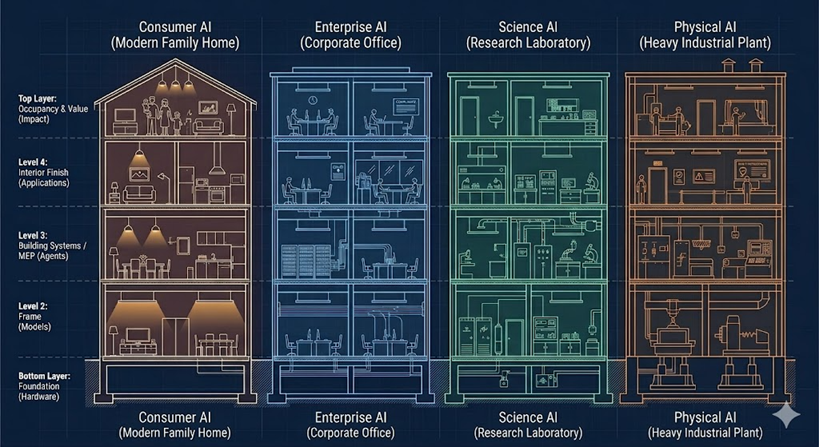
- What type of building are you constructing? A family home, a corporate office tower, a research laboratory, or an industrial plant?
- What phase of construction are you in? Laying the foundation, erecting the structural frame, running the building systems, finishing the interiors, or handing it over to occupants?
Either question alone tells you something. But neither tells you enough.
Knowing you are in the “electrical wiring phase” tells you the work involves circuits, conduit, and power loads. But it tells you nothing about what that work actually demands. Wiring a family home means standard outlets, consumer-grade cable, and a one-day inspection. Wiring a hospital means medical-grade isolation transformers, redundant emergency circuits, life-safety compliance reviews, and weeks of testing. The phase name is identical. The engineering reality could not be more different.
You need to know both the building type and the construction phase to understand what you are really dealing with.
This is exactly how the AI landscape works:
- The Pillar tells you what type of “building” you are constructing—Consumer AI (a well-appointed home: built for comfort, speed, and personal delight), Enterprise AI (a commercial office tower: governed, integrated, inspected at every phase), Science AI (a precision research laboratory: every measurement matters, everything must be validated), or Physical AI (an industrial plant or a bridge: safety-critical, certified at every layer, because failure is not an option).
- The Layer tells you what construction phase you are in—Hardware (the foundation and site work), Models (the structural frame), Agents & Tools (the MEP systems—mechanical, electrical, plumbing—the systems that make the building actually function), Applications (the interior finish: what occupants see and interact with), or Impact (occupancy and value: what the building delivers when people use it).
When you combine these two dimensions, you get a blueprint grid—a 4×5 matrix that lets you place any AI development into a specific, meaningful position. And just like an architect reading a blueprint instantly understands that “running MEP systems in a hospital” is an entirely different undertaking than “running MEP systems in a family home,” your position on this grid instantly reveals the constraints, timelines, and risks of any AI initiative.
The goal of this framework is not a classification exercise. It is to give you a decision tool—a way to read any AI initiative the way an experienced architect reads a blueprint: understanding what it truly demands before you commit to building it.
The Matrix: Your AI Blueprint Grid
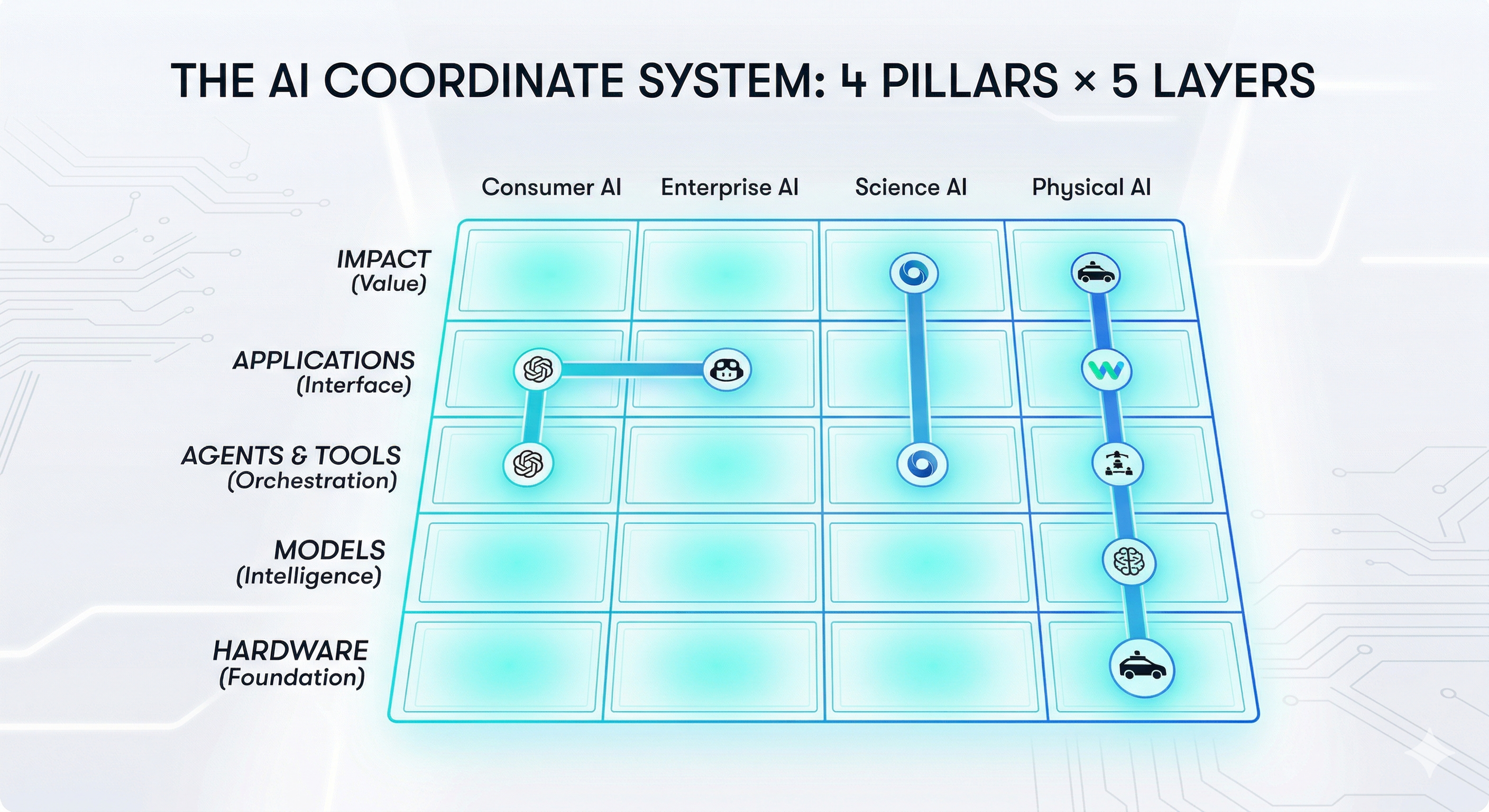
When you are embarking on an AI initiative, the grid gives you four immediate questions to answer—each one revealing a different dimension of what the work actually demands:
- Which layers require investment (Do you need custom hardware, or can you use existing infrastructure?)
- What constraints will dominate (Is speed critical, or is accuracy non-negotiable?)
- Where dependencies lie (Does your application layer depend on breakthroughs in the model layer?)
- What adjacent developments matter (If you are building in Enterprise AI Layer 3, what’s happening in Consumer AI Layer 3 might signal future trends)
This blueprint grid transforms AI from an overwhelming landscape into a structured plan. Instead of asking “How do I keep up with AI?”, you can ask “What’s happening at the specific position in the grid which is my area of focus, and in the adjacent cells that matter?”
How the Same Layer Behaves Differently Across Pillars
Here is the key insight that makes this matrix powerful, not just being an academic excercise: the same layer behaves radically differently depending on which pillar you are in.
As with the wiring example—the phase name is the same, but the demands are not. Let me show you how this plays out with Layer 2 (Models), since that is the layer most people associate with “AI.”
- A Consumer AI Model (like ChatGPT) is optimized for speed, creativity, and conversational flow. Accuracy is important, but a small mistake is forgiven. Users regenerate and move on.
- An Enterprise AI Model used for financial reporting must be bulletproof. A hallucination here is not an inconvenience—it is a legal liability.
- A Science AI Model (like AlphaFold) must model the laws of physics accurately. “Close enough” is not acceptable when the output determines whether a drug candidate moves to clinical trials.
- A Physical AI Model controlling a robot arm must respond in milliseconds and never fail catastrophically. A wrong prediction is not a bad answer—it is a collision.
Same layer. Radically different behavior, constraints, and success criteria.
This pattern holds across every layer. To make it concrete, here is how Layer 1 (Hardware) and Layer 3 (Agents) look across all four pillars:
Hardware (Layer 1) Across the Pillars
| Pillar | Hardware Need | Key Constraint | Example |
|---|---|---|---|
| Consumer | Smartphones, laptops, edge devices | Cost and battery life—users won’t carry a $5,000 device | Apple’s Neural Engine running AI locally on iPhones |
| Enterprise | Cloud data centers with GPUs | Cost per query at scale—$0.10 per query × 1M daily queries = unsustainable | Microsoft Azure GPU clusters powering Copilot |
| Science | HPC clusters, specialized TPUs | Raw computational power—simulating molecular interactions requires massive parallelism | Google’s TPU pods training AlphaFold |
| Physical | Edge compute on robots, real-time processors | Ruggedness and power efficiency—a warehouse robot can’t be plugged into a wall | NVIDIA Jetson chips in autonomous delivery robots |
Agents & Tools (Layer 3) Across the Pillars
| Pillar | Agent Role | Key Constraint | Example |
|---|---|---|---|
| Consumer | Personal assistants for daily tasks | User trust and simplicity—complexity drives abandonment | Google Assistant coordinating calendar, email, and maps |
| Enterprise | Workflow automation (tickets, reports, routing) | Reliability and auditability—a wrong ticket priority creates business risk | Salesforce Einstein automating support triage |
| Science | Research agents proposing hypotheses, searching databases | Accuracy and domain expertise—a wrong hypothesis wastes months of lab work | AI agents in drug discovery suggesting molecular candidates |
| Physical | Control agents coordinating sensors, motors, navigation | Real-time safety—a 100ms delay can cause a collision | Waymo’s vehicle agent orchestrating perception, planning, and control |
The Speed Paradox: Why Each Pillar Evolves Differently
One of the most practically useful insights from this framework is understanding why different AI domains move at different speeds. This is something I wish more people internalized, because it is the antidote to AI FOMO.
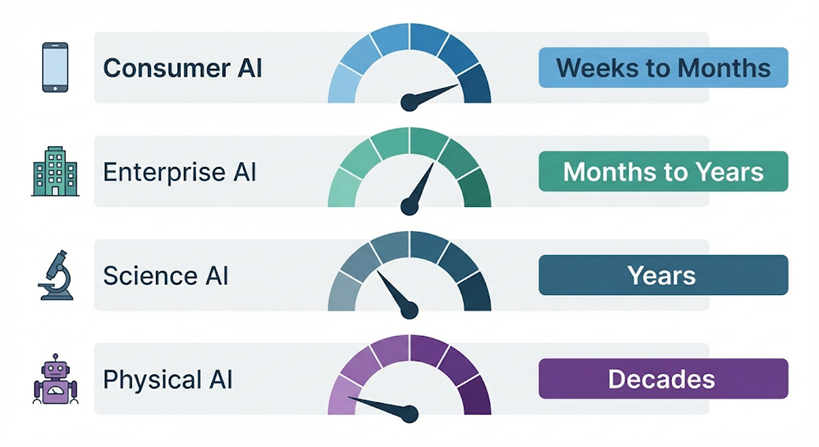
Consumer AI moves at software speed. New features ship weekly. ChatGPT’s interface changes monthly. A startup can go from idea to launch in weeks. Why? Because the constraints are lightweight—you need a fast model, a clean UI, and an internet connection. Layer 1 (Hardware) is someone else’s problem (cloud providers). Layer 5 (Impact) is measured in engagement, not life-or-death outcomes.
Enterprise AI moves at integration speed. Deployments take months to years. Why? Because Layer 3 (Agents) must connect to legacy systems, Layer 4 (Applications) must satisfy compliance and security reviews, and Layer 5 (Impact) must be measured in ROI—not vibes. Every new AI capability must pass through governance, procurement, and change management before it reaches a single employee.
Science AI moves at validation speed. Breakthroughs like AlphaFold take years to move from paper to practice. Why? Because Layer 5 (Impact) requires peer review, reproducibility, and cross-domain validation. A model that predicts protein structures must be verified by wet-lab experiments before anyone trusts it for drug design. Science AI changes humanity quietly—you rarely see it in headlines, but its long-term impact often exceeds everything else.
Physical AI moves at certification speed. Self-driving cars and surgical robots operate on timelines measured in decades. Why? Because every layer must be near-perfect simultaneously. Layer 1 (Hardware) must survive rain, heat, and impact. Layer 2 (Models) must handle edge cases that have never been seen before. Layer 5 (Impact) involves human safety, which means regulatory certification, insurance frameworks, and public trust—all of which move slowly and for good reason.
Why this matters to any one involved in rolling out AI initiatives: When you see a headline about a “breakthrough” in Physical AI, you can breathe. It will be years before it affects your daily work. When you see a breakthrough in Consumer AI, pay attention—it might change your workflow next month. The pillar tells you how fast the building codes—and the industry around them—are rewritten.
Applying the Framework: A Quick Start
Now that you have seen the matrix in action, here is a quick way to use it when you encounter any AI announcement, product, or project. I will expand this into a full practical methodology in Part 3 of the series, but for now, three questions will get you most of the way:
Question 1: Which pillar? Identify the building type. Is this consumer-facing, enterprise, scientific, or physical? The pillar immediately tells you the dominant constraint (delight, integration, accuracy, or safety) and the likely pace of development—just as knowing whether you are building a home or a hospital tells you immediately what standards, timelines, and failure tolerance apply.
Question 2: Which layers? Identify the construction phase. Which layers is this project investing in? If a company announces a “revolutionary AI product” but only focuses on Layer 2 (the model), it may lack the MEP systems (Layer 3 / Agents) or the finished interior (Layer 4 / Applications) to be usable. You can spot vaporware by identifying the phases that are missing or hand-waved away.
Question 3: Does this affect my position on the grid? The framework gives you permission to ignore 75% of AI news. If an announcement is not in your pillar or an adjacent layer, it is noise. A Science AI breakthrough (like AlphaFold) is fascinating, but if you are building consumer products, it is not immediately actionable.
Example: You read: “New multimodal AI model can understand video, audio, and text simultaneously!”
- Pillar: Likely Consumer AI (user delight) or Enterprise AI (workflow efficiency).
- Layers: Primarily Layer 2 (model improvement). But does it have Layer 3 integration or Layer 4 UX?
- Relevance: If you are building a video editing tool (Consumer), this is highly relevant and could reach your users in months. If you are in healthcare (Enterprise/Science), wait for domain-specific validation—it will take 1-2 years for integration.
In seconds, you have gone from “another overwhelming AI headline” to “I know exactly what this means for me.” That is the power of knowing your position on the grid.
Summary
In this post, we brought together the two dimensions of our framework—the 4 Pillars (where AI applies) and the 5 Layers (how AI creates impact)—into a single coordinate system.
The key insights:
- The matrix is a decision tool, not just a classification. Like a construction blueprint, your position on the grid reveals the building type (constraints), the construction timeline, and the safety requirements of any AI initiative.
- The same layer behaves radically differently across pillars. “Models” in Consumer AI means fast and forgiving. “Models” in Physical AI means flawless and real-time. The layer name is identical; the engineering reality is not.
- Each pillar evolves at its own speed. Consumer AI moves in weeks, Enterprise in months, Science in years, Physical in decades. Understanding this eliminates FOMO and helps you set realistic expectations.
- You can ignore 75% of AI news. Once you know your building type and construction phase, any announcement outside your pillar and adjacent layers is background noise—interesting, but not actionable for you right now.
With this blog the Part 1 of the blog series is now complete. You now should have a full mental model for understanding the AI landscape. But understanding the structure is just the beginning.
What’s Coming Next: Deep Diving Into Each Pillar
The blog posts in Part 2 of this series, we will take a detailed journey through each pillar, one at a time:
- Consumer AI: Where AI meets individual users. We will explore personalization, ambient computing, and the race for zero-friction interfaces.
- Enterprise AI: Where AI meets business processes. We will discuss agentic workflows, data readiness, and why most AI pilots fail.
- Science & STEM AI: Where AI accelerates discovery. We will look at AI-generated hypotheses, autonomous labs, and humanity-scale breakthroughs.
- Physical AI: Where AI enters the real world. We will examine robotics, autonomous systems, and the long game of building trust.
Each pillar will be analyzed through the 5 layers, with specific trends, constraints, and decision-making guidance.
By the end of Part 2, you will not only understand the landscape—you will know how to navigate it.
Author’s Note: AI-assisted writing tools were used to support the creation of this post. All concepts, perspectives, and the underlying thought process originate from me; the AI served only as a drafting and refinement aid
Published by Sri Rajalingam
CTO, Entrepreneur, Technology Evangelist & Trainer focused on building companies and helping Enterprises Apply and Adopt AI and Cloud to that cna help them to create real, measurable impact. View all posts by Sri Rajalingam
 Sri Rajalingam