
Introduction
We are standing at the beginning of a fundamental shift in how businesses operate and create value. For the past few years, the conversation around Generative AI has been dominated by awe at its capabilities—writing code, summarizing meetings, or generating marketing copy. But the true impact of GenAI is not just about what it can do; it is about what it does to the cost of doing it.
GenAI is driving the marginal cost of cognitive work—the cost to produce one additional unit of analysis, boilerplate code, or written content—close to zero. To understand this era of abundance, we have to look at the mechanisms driving this drastic fall in price of knowledge/cognitive work.
There are many debates happening around this topic and may experts have been sharing their thoughts around the future of workforce which will be a mix of human and digital that will be driving an era of abundance.
It triggered in me the curiosity to understand this and I embarked on doing research on the same, equipped with
- My hypothesis
- My Point of view from my knowledge of 3 decades of work experience
- Loads of questions around the Impact of GenAI.
Obviously there is no one future model of economy that addresses all challenges but at least it gave me some idea on the challenges and the options we have at hand. I decided to share what I learnt through a series of blogs under the title “Navigating the Era of Abundance” and this is the first part in that series.
The Dematerialization of Expertise
Historically, expertise was scarce, expensive, and bound by human physical limits. If an enterprise needed a complex compliance document reviewed or a foundational software module written, it had to make use of the services of a highly trained human brain by the hour.
GenAI takes that highly specialized expertise and “dematerializes” it ie. knowledge that used to be locked inside experts, tools, or long training cycles has been made accessible as a software that is lightweight, on‑demand and accessible instantly. It turns a bespoke service into a utility.
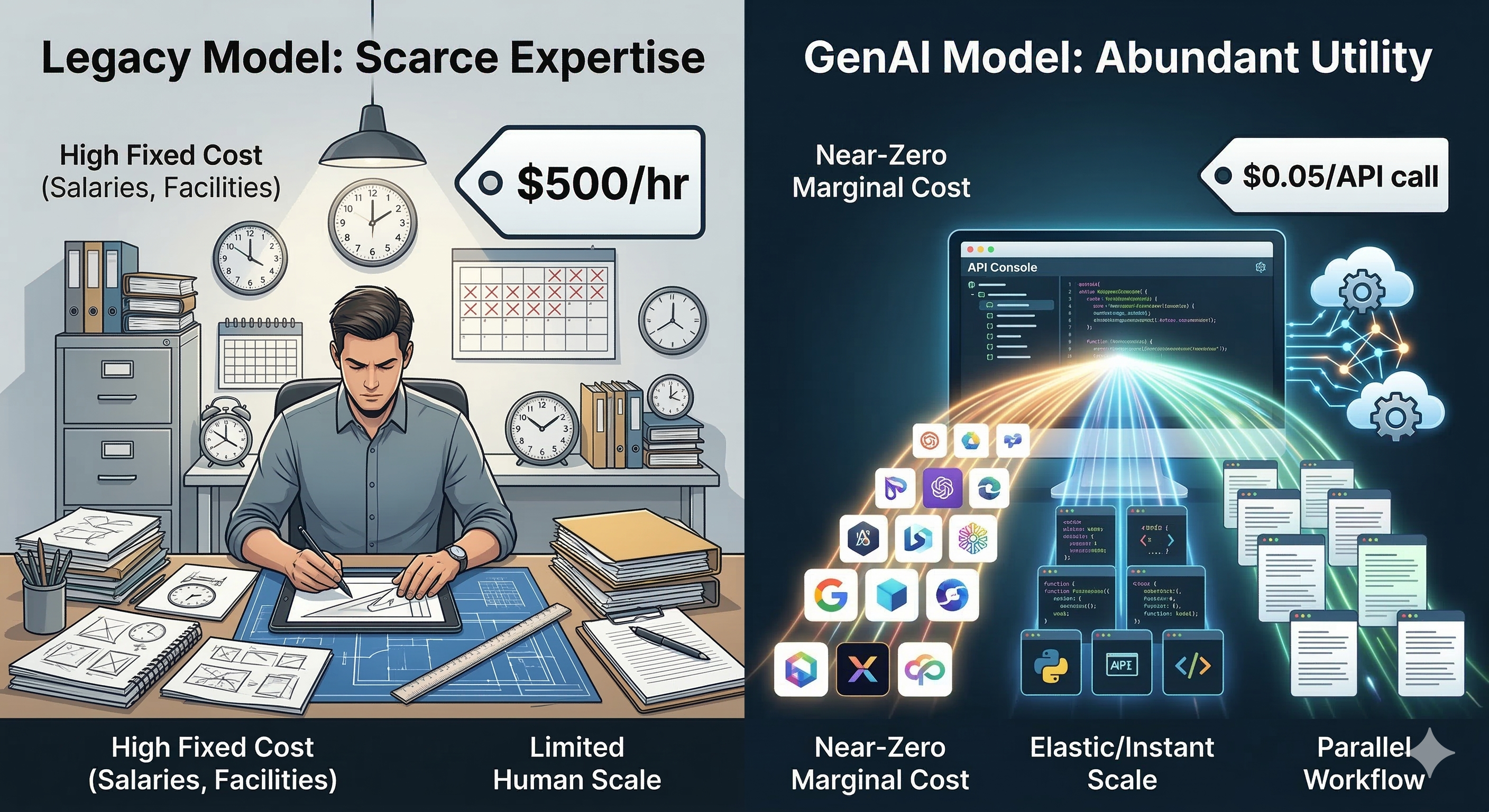
- The Legacy Model: You pay a specialized consultant or developer for three days of work to draft standard operating procedures or build a basic data pipeline.
- The GenAI Model: You pay fractions of a cent in compute power to generate a high-quality baseline draft or functional code structure in three seconds.
When the cost of generating high-quality cognitive output drops this drastically, it lowers the barrier to entry for innovation. Teams can experiment, build, and deploy at a velocity that was previously unaffordable.
The “Serverless” Metaphor for Cognition
If you are familiar with enterprise IT, you know the massive shift that occurred when migrating from “On-Premise” data centers to the Cloud.
- With traditional on-premise infrastructure, a company had to buy expensive physical servers to handle peak loads. Whether those servers were running at 100% capacity or sitting idle over the weekend, the enterprise paid the same massive fixed cost.
- Cloud computing introduced the On Demand and Serverless model. Companies stopped paying for idle hardware and began paying only for the exact milliseconds of compute they actually consumed.
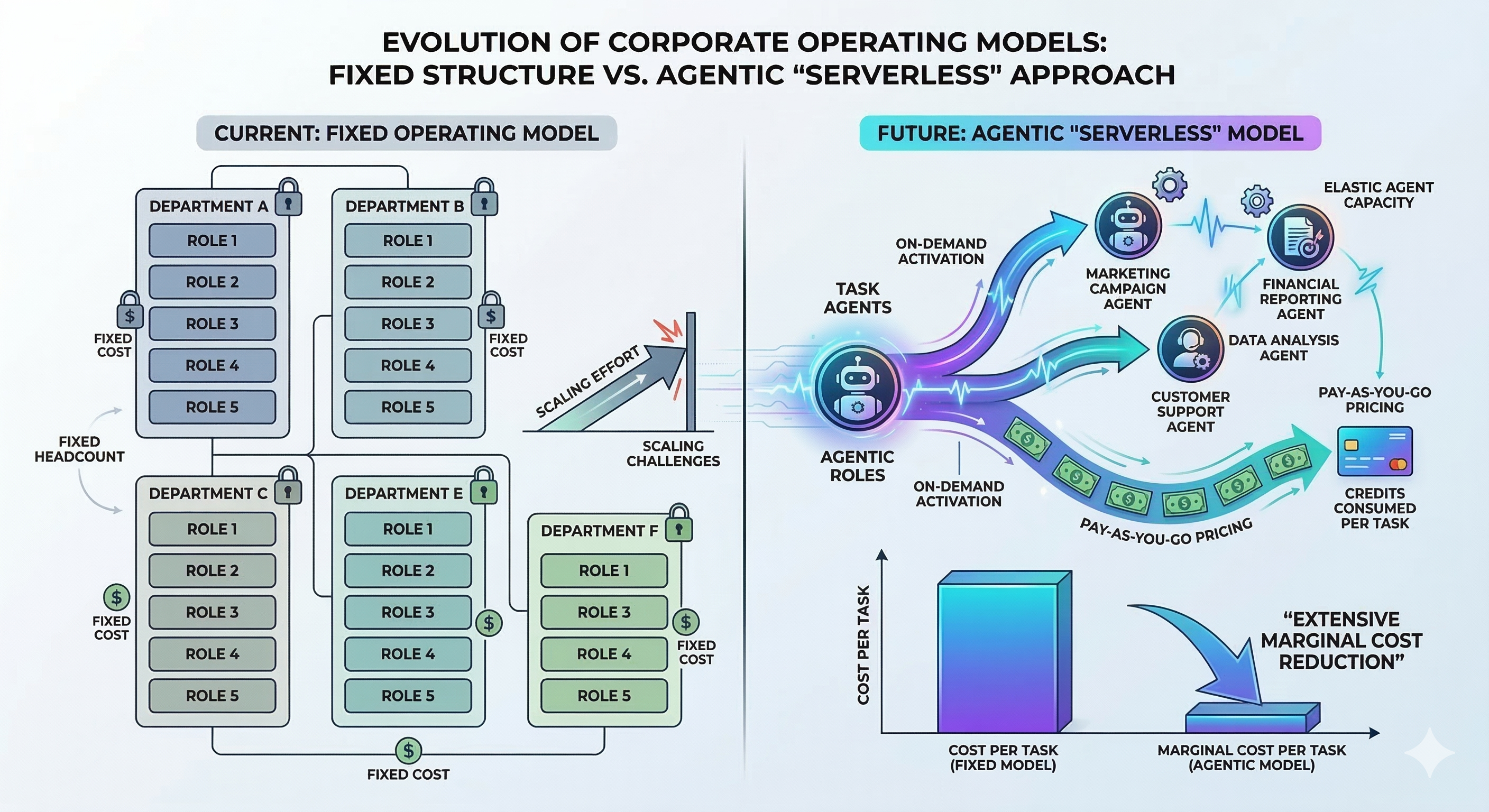
You can think of GenAI doing exactly this to human cognition in the context of corporate operating model. Right now, much of the corporate world operates on “On-Premise Cognition”. Companies maintain large teams to handle baseline operational tasks. They pay a fixed cost (salaries, benefits, office space) regardless of whether those teams are actively solving complex strategic problems or just formatting weekly status reports.
GenAI introduces “Serverless Cognition.” Instead of carrying a heavy fixed cost for routine, repetitive tasks, companies can call upon an AI agent to execute a workflow—such as translating legacy code, QA testing, or analyzing a spreadsheet—and they only pay for the API call. This elasticity allows an organization to scale its intellectual output up or down instantly, radically lowering the baseline cost of running a business.
Where Abundance Hits First
This economic shift may not happen everywhere all at once. It may start with transforming “bits” (digital goods) post which slowly transform other areas including transforming the “atoms” (physical space). We can already see a first wave of cost deflation happening in digital-first environments today:
- Software Engineering: The generation of boilerplate code, unit tests, and routine debugging is becoming near-free. This does not replace engineers; it acts as a massive multiplier. A small, focused team can now output the volume of a traditional enterprise-scale engineering department.
- First-Line Knowledge Work: Routine data synthesis—like summarizing customer calls, pulling insights from massive HR databases, or categorizing IT support tickets—is shifting from a human bottleneck to an instant, automated background process.
- Digital Media & Communications: The cost to produce highly personalized text, training materials, and internal communications is plummeting, allowing organizations to provide tailored information at scale.
The engine of abundance is ultimately about unblocking bottlenecks that can help use cognition and knowledge for better use. When the cost to draft, code, and synthesize approaches zero, teams are freed from administrative drag, allowing them to focus entirely on strategy, architecture, and high-level problem solving.
 Sri Rajalingam