
Why AI Feels Overwhelming — And Why That’s the Wrong Way to Look at It
Introduction
In case of people who closely follow AI related developments as well as for people who are in early stages of understanding the AI landscape its become very hard to track the developments in the space and understand how new technologies, tools, techniques and solutions can be applied in their respective domains and use case ideas they have. For the ones closely following developments in AI space every morning, it feels like the landscape of Artificial Intelligence has shifted overnight. You wake up to a barrage of headlines: a new Large Language Model (LLM) that crushes previous benchmarks, a new image generator that renders reality perfectly, or a new agentic tool that promises to automate your entire workflow.
For engineers, leaders, and decision-makers, this constant acceleration often triggers a mix of excitement and anxiety. There is a pervasive fear of falling behind—the sense that if you don’t master this specific tool released today, you will be obsolete tomorrow. This is “AI Fatigue,” and it is the natural result of trying to drink from a firehose without a cup.
The objective of this blog series, Applied AI Thoughts for Realization, is to help the readers to put down the firehose and step back. The objective is not to cover the latest news or review the newest tools. Instead, the goal of the blogs in this series is to provide you with a structured mental model—a way to organize the chaos into a coherent map.
Over the course of this series, I will try to avoid the hype cycles and focus on a first-principles approach to understanding the AI landscape. I will help you to explore how to categorize AI into distinct “Domain Pillars” based on where it is applied, and how to understand the dependencies and progress within the Domain Pillars through specific “Impact Layers.”
By the end of this series, you won’t just have more information; you will have a mental model framework. When you encounter any news about new AI developments or innovations—whether it’s a breakthrough in consumer gadgets, an enterprise platform launch, or a scientific research milestone—you will be able to instantly map it to its specific domain pillar and identify which layer it operates within. This clarity will help you understand not just what the announcement is, but where it fits in the broader landscape, why it matters in that context, and whether it’s relevant to your work.
The Problem the Series helps to Solve : The Trap of Tactical Thinking
Imagine you decide to build a house. You walk into a massive hardware store, credit card in hand.
On Monday, you buy a power drill because the salesperson says it’s the fastest one ever made. On Tuesday, you see a new type of saw that uses lasers, so you buy that too. On Wednesday, you hear about a revolutionary type of hammer, so you rush back to the store.
By the end of the week, your garage is full of cutting-edge tools. You are exhausted from researching specs and comparing brands. But when you look at your empty lot, you realize a painful truth: You haven’t laid a single brick. You have a collection of tools, but you don’t have a blueprint.
This is exactly where most of us are with Artificial Intelligence today. We are stuck in Tactical Thinking.
We treat AI as a shopping list of features and vendors. We obsess over the “tools”:
- “Did you see the context window on that new model?”
- “Is OpenAI better than Google for coding?”
- “Should we use RAG or fine-tuning?”
While these questions aren’t irrelevant, asking them first is a trap. When you focus solely on the tools, you become reactive. You are constantly pivoting based on the latest press release. You judge AI progress by how fast the “drill” spins (model benchmarks), rather than whether it can actually help you build the “house” (solve a specific problem).
This tactical approach leads to two major issues:
- Paralysis: You are afraid to commit to a solution because something better might come out next week.
- Misalignment: You try to force a tool into a job it wasn’t meant for—like trying to frame a house with that laser saw just because it was expensive.
To escape this cycle, we need to stop looking at the tools and start looking at the architecture.
The Shift: From Tools to Structure
The antidote to tactical paralysis is Structural Thinking.
If tactical thinking asks “What tool should I use?”, structural thinking asks “Where does this problem live, and what are the constraints of that environment?”
When you shift your mindset from tools to structure, you stop chasing every new announcement. You realize that AI is not a single, monolithic wave washing over everything in the same way. Instead, it is a set of capabilities that behaves radically differently depending on the context.
Why Structure Matters for Scalability and Flexibility
The biggest advantage of structural thinking is that it future-proofs your strategy.
In the tactical world, your strategy is brittle. If you build your entire workflow around a specific vendor’s model, and that vendor changes their pricing or a competitor releases a better model next month, your strategy breaks. You are constantly rebuilding.
In the structural world, your strategy is flexible. You define the architecture of your solution—the data flows, the safety guardrails, the user interaction patterns—independent of the specific engine powering it.
- If a new, faster model comes out? You simply swap it in as a component.
- If a regulation changes? You adjust your governance layer without tearing down the whole application.
Structural thinking allows you to build systems that last, rather than prototypes that expire. It moves you from being a consumer of technology to an architect of solutions. It forces you to acknowledge that a “good” AI system for writing a marketing email is fundamentally different from a “good” AI system for controlling a robotic arm—not just because the tools are different, but because the structure of the problem (risk, speed, cost, accuracy) is different.
The Solution: A Preview of the Framework
To navigate this landscape effectively, we need a map. Over years of working with AI across various domains, I have developed a mental model that breaks the AI world down into two distinct dimensions. Think of it as a coordinate system for understanding any AI development.
Dimension 1: The 4 Domain Pillars (Where AI Applies) First, we must recognize that “AI” is not a single thing. It is a set of technologies applied in radically different environments. We divide the landscape into four vertical pillars:
- Consumer AI: The AI we use in our daily lives (chatbots, image generators).
- Enterprise AI: The AI that powers businesses (automation, data analysis).
- Science & STEM AI: The AI that accelerates discovery (drug discovery, material science).
- Physical AI: The AI that interacts with the real world (robotics, autonomous systems).
Dimension 2: The 5 Impact Layers (How AI Progresses) Within each pillar, progress doesn’t happen in a vacuum. It moves through layers of maturity, from the raw silicon to the final societal change:
- Hardware: The chips and infrastructure.
- Models: The algorithms and intelligence.
- Agents & Tools: The orchestration that makes models useful.
- Applications: The interfaces we actually touch.
- Impact: The real-world value and behavioral change created.
The Power of the Grid When you combine these, you get a grid. You can place any news story, any tool, or any project onto this grid. Suddenly, the chaos disappears. You aren’t just looking at “AI”; you are looking at “Layer 2 (Models) within Pillar 3 (Science).” Below is a diagram that helps understand the framework.
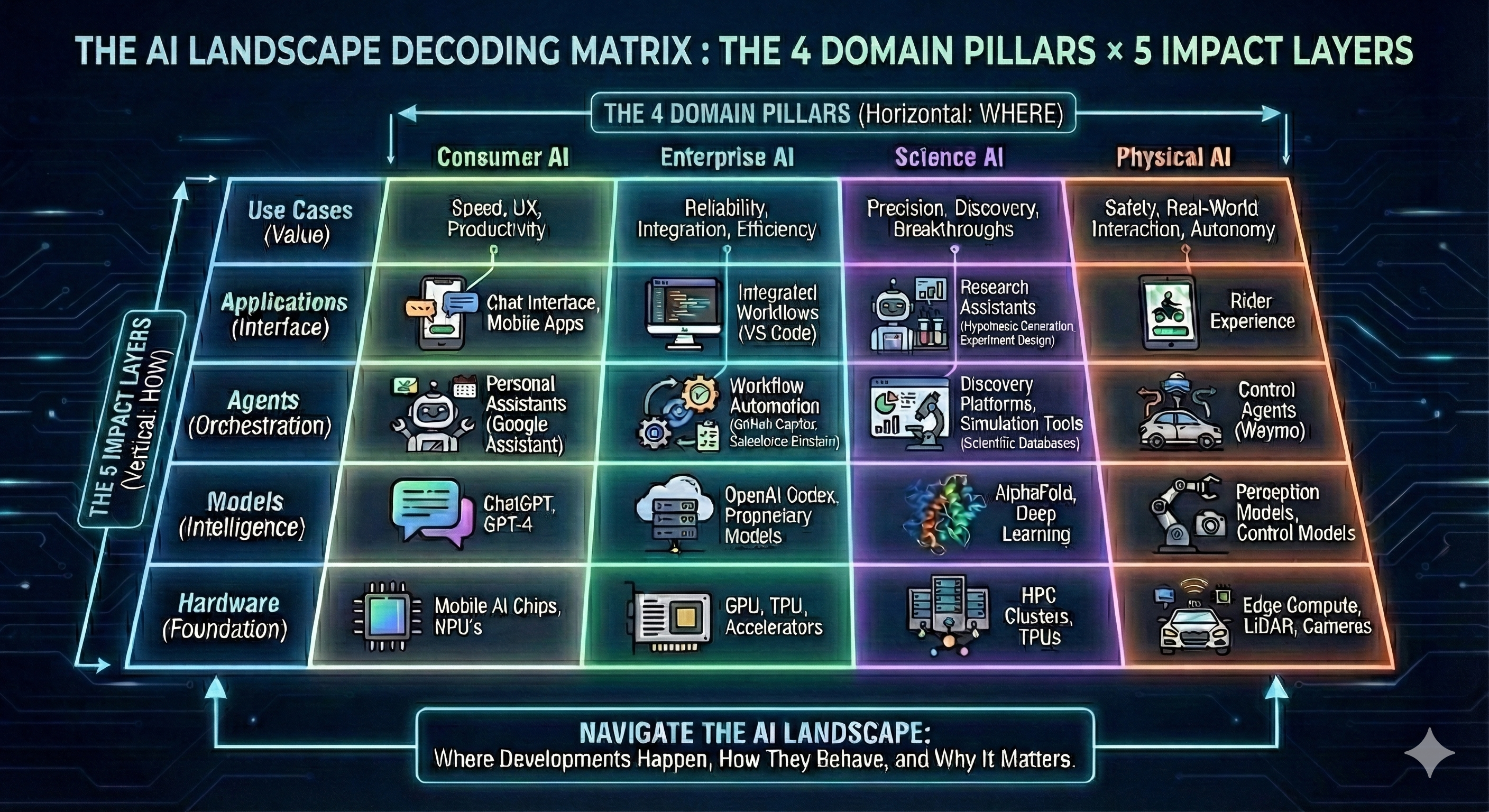
This framework allows you to ignore the noise that doesn’t affect your specific coordinates and focus deeply on the areas that do.
What to Expect from This Series
This blog post is just the starting point. Over the coming weeks, we will unpack this framework piece by piece, giving you the tools to apply it to your own work.
Here is the roadmap for the series:
-
Part 1: Foundational Thinking We will dive deeper into the mental models. We’ll explore the 4 Domain Pillars in detail to understand their unique characteristics, and we’ll break down the 5 Layers to see how innovation actually flows from hardware to impact.
-
Part 2: Pillar-by-Pillar Deep Dives We will dedicate specific articles to each of the four domain pillars—Consumer, Enterprise, Science, and Physical AI. We will analyze the specific trends, constraints, and opportunities within each domain.
-
Part 3: Applying the Framework Finally, we will turn theory into practice. We will discuss how to use this framework to make better decisions, whether you are evaluating a new vendor, planning an internal AI project, or simply trying to stay ahead of the curve.
By the end of this journey, you will have a clear, reusable lens through which to view the AI landscape—one that turns information overload into actionable insight.
References
Author’s Note: AI-assisted writing tools were used to support the creation of this post. All concepts, perspectives, and the underlying thought process originate from me; the AI served only as a drafting and refinement aid
 Sri Rajalingam